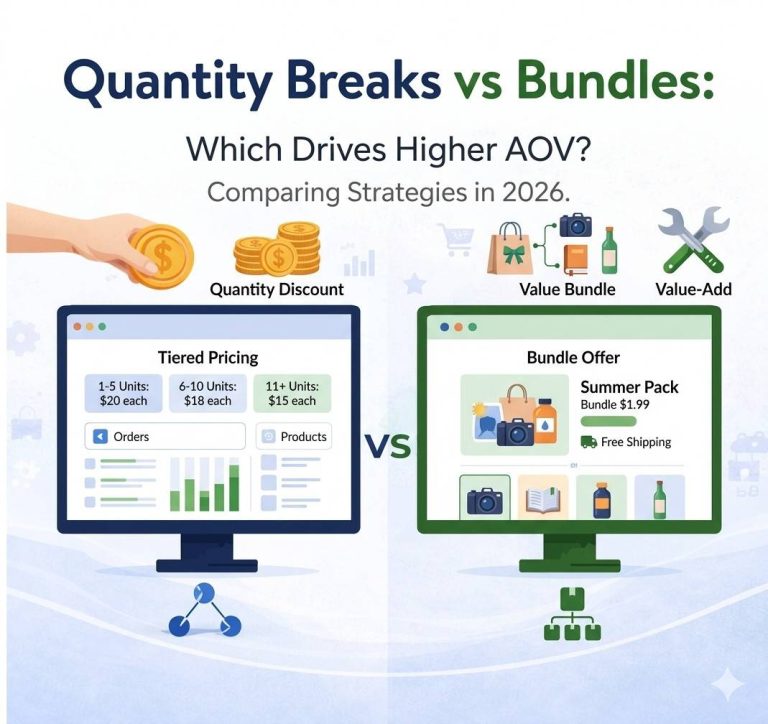
Quantity breaks and bundles both increase average order value, but they work through different buying triggers. Quantity breaks drive higher AOV when customers already intend to buy multiples, while bundles perform better when customers need guidance on what to buy together. Shopify merchants who want consistent AOV growth often use both—implemented through a single, flexible system like Adoric Bundles Quantity Breaks.
Why This Comparison Matters for Shopify Merchants
Most Shopify stores focus on traffic, but AOV is often the faster and more controllable growth lever. The challenge is that merchants usually pick either bundles or quantity breaks without understanding how each affects customer psychology.
In practice, what we see across Shopify stores is simple: using the wrong pricing mechanic for the wrong product doesn’t just limit AOV—it actively hurts conversion.
This article breaks down when quantity breaks win, when bundles win, and how to decide based on product behavior, not trends.
What Quantity Breaks Actually Optimize
Quantity breaks reward customers for buying more of the same product. The value is immediately clear and tied directly to quantity.
Typical examples:
- Buy 2 → save 10%
- Buy 3 → save 20%
Quantity breaks work best when customers already understand the product and don’t need additional context to buy more.
They’re especially effective for:
- Consumables (supplements, skincare, pet products)
- Replenishable items
- Low-friction repeat purchases
Because the decision is incremental, quantity breaks tend to scale AOV without increasing cognitive load.
For a deeper foundation on how this fits into bundling strategy overall, see how to Create Product Bundles on Shopify
What Bundles Actually Optimize
Bundles optimize decision clarity, not quantity alone. Instead of asking customers to buy more units, bundles guide them toward a predefined combination that “makes sense.”
Common bundle examples:
- Starter kits
- Complete sets
- Routine-based bundles
Bundles perform best when customers are unsure what to buy together or when the perceived value of the combination matters more than unit price.
They’re especially effective for:
- Apparel (outfits, multi-SKU sets)
- Beauty routines
- Electronics + accessories
Bundles often improve both AOV and conversion rate because they simplify choice.
Quantity Breaks vs Bundles: AOV Impact by Scenario
When Quantity Breaks Drive Higher AOV
Quantity breaks typically outperform bundles when:
- Customers already want more than one unit
- Products are identical or highly similar
- Price sensitivity is high
- Repeat usage is obvious
In these cases, bundles add unnecessary friction. Customers don’t need guidance—they need incentive.
When Bundles Drive Higher AOV
Bundles outperform quantity breaks when:
- Products are complementary
- Customers are unsure what to combine
- Education is part of the purchase
- Value perception matters more than price
Here, quantity discounts alone don’t help because the problem isn’t price—it’s decision fatigue.
Why Most Stores Choose the Wrong One
The most common mistake Shopify merchants make is treating bundles and quantity breaks as interchangeable. They’re not.
What usually goes wrong:
- Quantity breaks applied to unrelated products
- Bundles created for products customers already buy in bulk
- Both strategies hidden below the fold
- No testing by product type
This leads to lower AOV, not higher.
For related checkout behavior issues, see
How to Reduce Abandoned Carts.
The Highest-Performing Approach: Combining Both
The highest-AOV Shopify stores don’t choose between bundles and quantity breaks—they layer them intentionally.
Examples:
- Quantity breaks on core products
- Bundles for onboarding or first-time buyers
- Add-on bundles triggered after quantity selection
This is where merchants need flexibility. Managing both strategies separately often creates inventory, UX, and analytics issues.
That’s why many stores use Adoric Bundles Quantity Breaks as a single system to manage quantity discounts and bundle logic together, instead of stacking multiple apps.
For a broader look at how bundling impacts revenue, see
How to Boost Sales & Enhance Customer Experience with Bundling.
Common Mistakes That Kill AOV
These mistakes consistently reduce results:
- Using quantity breaks on low-margin products
- Creating bundles without clear value logic
- Forcing bundles when customers want flexibility
- Over-discounting instead of framing value
- Treating AOV tactics as short-term campaigns
AOV growth works best when pricing logic is always on, not promotional.
Which Strategy Should You Choose?
The right question isn’t “which is better?”
It’s “what behavior does my product already encourage?”
- If customers naturally buy multiples → quantity breaks
- If customers need guidance → bundles
- If both apply → combine them
This decision should be product-level, not storewide.
Frequently Asked Questions
Are quantity breaks better than bundles for AOV?
Quantity breaks perform better when customers already intend to buy multiple units, while bundles excel when decision guidance is needed.
Do bundles convert better than quantity discounts?
Often yes, especially for complex or complementary products where clarity matters more than price.
Can you use quantity breaks and bundles together?
Yes—and high-performing Shopify stores often do, using a unified system.
Which works better for low-priced products?
Quantity breaks usually outperform bundles for low-ticket, repeat-purchase items.
What mistakes reduce AOV with bundles or quantity breaks?
Over-discounting, poor placement, and mismatching strategy to product behavior are the most common issues.
Final Thought
Quantity breaks and bundles don’t compete—they solve different problems. The fastest AOV growth happens when pricing logic aligns with how customers already want to buy.