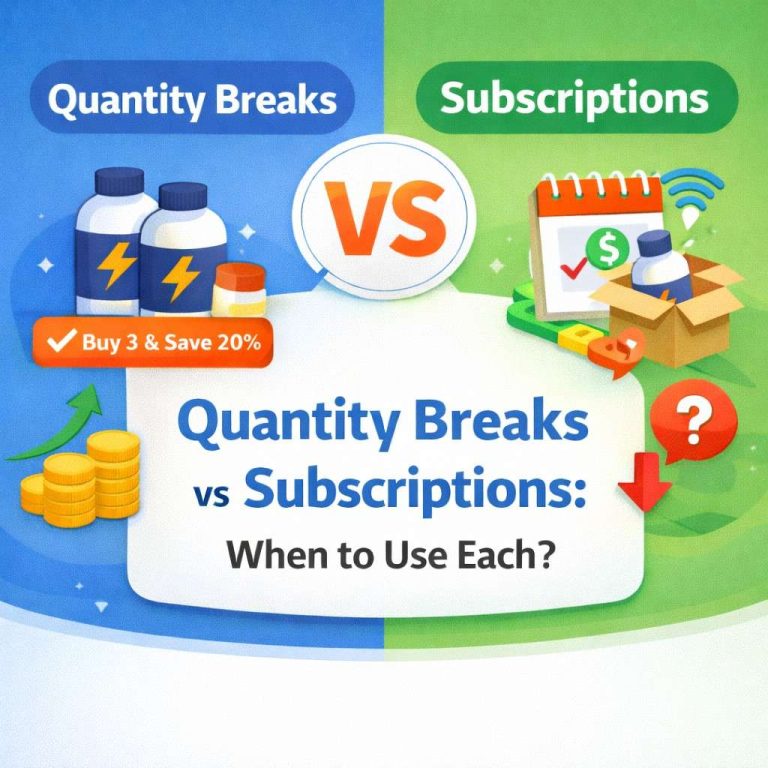
Quantity breaks work best when customers naturally buy more in a single order, while subscriptions work best when customers commit to repeat purchases over time. If your goal is immediate AOV growth with minimal friction, quantity breaks usually outperform subscriptions; if your goal is predictable recurring revenue, subscriptions can be effective—but only for the right products and audiences.
Why This Comparison Comes Up So Often
As Shopify merchants mature, they start looking beyond traffic and focus on revenue efficiency. Two strategies usually surface early: offering quantity discounts or launching subscriptions.
On paper, both promise higher lifetime value. In practice, they solve different problems and fail for different reasons. Understanding when each model works—and when it doesn’t—is critical before changing pricing, UX, or fulfillment workflows.
This is also where quantity-based bundles, like those created with Adoric Bundles Quantity Breaks, often become the first step merchants take before committing to subscriptions.
What Quantity Breaks Actually Do
Quantity breaks reward customers for buying more right now. Instead of changing the product, they change the pricing logic.
Examples:
- Buy 2, save 10%
- Buy 3, save 20%
- Tiered pricing per unit
This works because it aligns with existing buying intent. The customer already wants the product; you’re simply shaping how much they buy in one transaction.
Quantity breaks tend to:
- Increase average order value immediately
- Preserve conversion rate
- Require no long-term commitment from the buyer
What Subscriptions Actually Do
Subscriptions ask customers to commit to future purchases. Instead of buying more now, they agree to buy again later.
This works when:
- The product is consumed regularly
- Replacement timing is predictable
- The customer sees clear long-term value
Subscriptions shift revenue from AOV to retention and predictability, but they also introduce friction: commitment anxiety, churn management, and operational complexity.
Quantity Breaks vs Subscriptions: Behavioral Differences
Quantity Breaks Influence Confidence
Quantity breaks lower hesitation by making the “better deal” obvious. The decision stays transactional and low-risk.
This is why quantity breaks perform especially well in:
- Apparel basics
- Supplements
- Beauty consumables
- B2B-lite products
They encourage stocking up without changing the buyer’s mental model.
Subscriptions Influence Commitment
Subscriptions change the nature of the relationship. The customer must trust:
- Product quality over time
- Delivery reliability
- Ongoing relevance
This can reduce conversion rates upfront, especially for first-time buyers.
For insight into how pricing affects buying behavior more broadly, see
How to Increase Average Order Value Without Discounts
When Quantity Breaks Clearly Win
Quantity breaks usually outperform subscriptions when:
- Customers buy sporadically, not on a strict schedule
- Products are affordable enough to buy multiples
- Margins support volume incentives
- The store is still optimizing conversion rate
In many cases, quantity breaks become the proof layer that later justifies subscriptions. If customers won’t buy three units now, they’re unlikely to commit long-term.
This is why many merchants use quantity breaks as the first pricing lever before exploring subscriptions.
When Subscriptions Actually Make Sense
Subscriptions tend to work best when:
- Consumption is frequent and predictable
- The product becomes part of a routine
- Customers already trust the brand
- The business can handle churn and lifecycle management
Strong examples include:
- Coffee
- Supplements with daily use
- Pet food
- Skincare replenishment
Even then, subscriptions usually perform better after a customer has purchased at least once.
Can Quantity Breaks and Subscriptions Work Together?
Yes—but in a specific order.
A common pattern among high-performing Shopify stores:
- Use quantity breaks to increase first-purchase AOV
- Identify repeat buyers
- Offer subscriptions only to proven segments
This sequencing reduces friction and improves subscription adoption quality.
Operational and UX Trade-Offs
Quantity breaks:
- Simple to explain
- Easy to test
- Low operational overhead
- Minimal customer support impact
Subscriptions:
- Require lifecycle communication
- Introduce churn and pause flows
- Affect inventory forecasting
- Increase support complexity
Many merchants underestimate this difference and launch subscriptions too early.
Common Mistakes Merchants Make
- Launching subscriptions before validating repeat demand
- Forcing subscriptions on first-time buyers
- Treating quantity breaks as “discounts” instead of pricing strategy
- Using both models simultaneously without clear positioning
- Ignoring the UX cost of long-term commitment
Most failures come from misaligned expectations, not bad tools.
Frequently Asked Questions
Are quantity breaks better than subscriptions for AOV?
Yes, quantity breaks usually increase AOV more reliably because they influence the current purchase, not future behavior.
When should a Shopify store offer subscriptions?
Only when repeat usage is predictable and customers already trust the product.
Can quantity breaks and subscriptions coexist?
Yes, but quantity breaks should typically come first, with subscriptions introduced later.
Do subscriptions reduce conversion rates?
They often do, especially for new customers or discretionary products.
What products should not be sold via subscriptions?
Low-frequency, impulse, or non-consumable products usually perform poorly as subscriptions.
Final Thoughts
Choosing between quantity breaks and subscriptions isn’t about which model is “better.” It’s about when each model aligns with how your customers already buy.
If customers aren’t willing to buy more today, they rarely want to commit to tomorrow. In that sense, quantity breaks often reveal more truth about demand than subscriptions ever will.