When you sell low-priced products, increasing traffic alone rarely improves profitability. The key is increasing average order value (AOV) so each checkout includes multiple items. Strategies like bundles, quantity breaks, and product sets—often implemented with tools such as Adoric Bundles Quantity Breaks—encourage customers to buy more items per order without relying on constant discounts.
Low-priced products create a unique ecommerce challenge.
They convert easily—but often produce small orders.
The Real Problem With Low-Priced Products
Many Shopify stores sell products priced between $5 and $30.
Examples include:
- Cosmetics
- Snacks and consumables
- Apparel basics
- Accessories
- Hobby supplies
These products often convert well because the price barrier is low.
But they introduce a different problem:
Small carts.
If a customer buys a single $12 product:
- Payment processing fees remain the same
- Shipping costs remain the same
- Customer acquisition cost remains the same
This leaves very little margin.
Increasing order size becomes critical.
The AOV Equation for Low-Ticket Ecommerce
For stores selling low-priced items, revenue growth usually comes from purchase depth, not higher prices.
Example:
| Scenario | AOV |
|---|---|
| Customer buys 1 item | $12 |
| Customer buys 3 items | $36 |
| Customer buys 4 items | $48 |
If your average order grows from $12 to $36, revenue triples without increasing traffic.
That’s why AOV is often the primary growth lever for low-priced products.
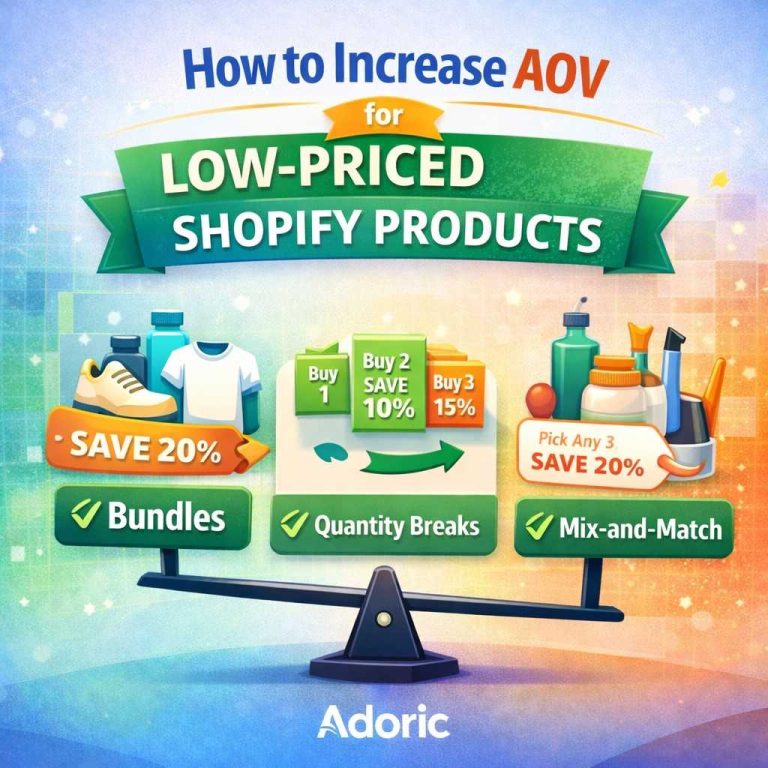
Strategy 1: Quantity Breaks (“Buy More, Save More”)
Quantity breaks are one of the most effective AOV strategies for low-priced products.
Example structure:
Buy 1 → Full price
Buy 2 → Save 10%
Buy 3 → Save 15%
This works because customers naturally think in multiples when products are inexpensive.
Examples:
- Lip balms
- Socks
- Coffee pods
- Supplements
- Phone accessories
Instead of deciding whether to buy, customers start deciding how many to buy.
Many Shopify merchants implement this approach using Adoric Bundles Quantity Breaks, which places the tiered pricing directly next to the purchase button on product pages.
Strategy 2: Create Product Bundles
Bundles combine complementary products into a single offer.
Example:
Skincare bundle
- Cleanser
- Serum
- Moisturizer
Instead of selling three individual products, the bundle encourages customers to purchase the complete routine.
Bundles work particularly well when products are naturally used together.
Examples:
- Coffee beans + filters
- Resistance bands + workout guide
- Camera + tripod + memory card
Bundles increase both AOV and product discovery.
Strategy 3: Mix-and-Match Offers
Mix-and-match bundles allow customers to choose their own combination of products.
Example:
“Choose any 3 items and save 20%.”
This strategy works especially well for:
- Apparel basics
- Snacks and beverages
- Beauty products
- Gift sets
Customers enjoy flexibility while still increasing cart size.
Strategy 4: Build Product Sets
Product sets guide customers toward logical multi-item purchases.
Example:
Starter kit
- Product A
- Product B
- Product C
This works well in categories where customers may not know what they need.
Examples include:
- Skincare routines
- Hobby equipment
- Fitness gear
Product sets reduce decision friction.
Strategy 5: Improve Bundle Visibility
Even strong offers fail when customers don’t see them.
Bundles and quantity breaks perform best when placed:
- On the product page
- Near the Add to Cart button
- Inside the purchase decision area
Placement directly influences adoption.
Many stores place bundles too far down the page where customers never notice them.
Real Shopify Examples
Coffee Brand
Products priced around $14 per bag.
Problem: Customers purchased one bag.
Solution:
Buy 2 → Save 10%
Buy 3 → Save 15%
Customers began purchasing a monthly supply instead of a single bag.
Apparel Basics Store
Products priced around $18 per item.
Offer:
Buy 2 → Save 12%
Result: Customers began purchasing multiple items instead of a single product.
Skincare Brand
Average product price: $22.
Solution:
Routine bundle combining three products.
Customers purchased the full set instead of one item.
When Bundles Don’t Work Well
Bundles may be less effective when:
- Products are expensive
- Products are rarely purchased together
- Inventory turnover is unpredictable
In those cases, other AOV strategies such as subscriptions or accessories may work better.
However, for low-priced products, bundles and quantity breaks remain among the most reliable levers.
Common Mistakes Merchants Make
- Discounts that are too small to change behavior
- Overcomplicated bundle structures
- Bundling unrelated products together
- Placing bundles too low on the page
- Treating bundles as temporary promotions
Bundles work best when they become part of the store’s buying experience, not just a seasonal campaign.
Why AOV Matters More for Low-Priced Products
When products are inexpensive, each order must contain multiple items to remain profitable.
Increasing AOV means:
- Better margins per order
- Lower relative shipping costs
- Higher revenue per customer
In other words, every visitor becomes more valuable.
FAQ
How do low-priced products affect Shopify profitability?
Low-priced products often produce small carts, which reduces margins after fees and shipping costs.
What AOV strategies work best for low-ticket products?
Bundles, quantity breaks, and mix-and-match offers are typically the most effective.
Do bundles work for cheap products?
Yes. In fact, bundles often perform better for inexpensive products because customers are comfortable purchasing multiple units.
How many items should a bundle include?
Most successful bundles include 2–4 items, depending on price and product category.
Can quantity breaks increase repeat purchases?
Yes. When customers buy multiple units, they are more likely to continue using the product and reorder.
Selling low-priced products isn’t the problem.
The real question is how your store encourages customers to buy more than one item at a time.
So when you look at your product pages, ask yourself:
Are you optimizing for a single-item purchase—or for a multi-product order?