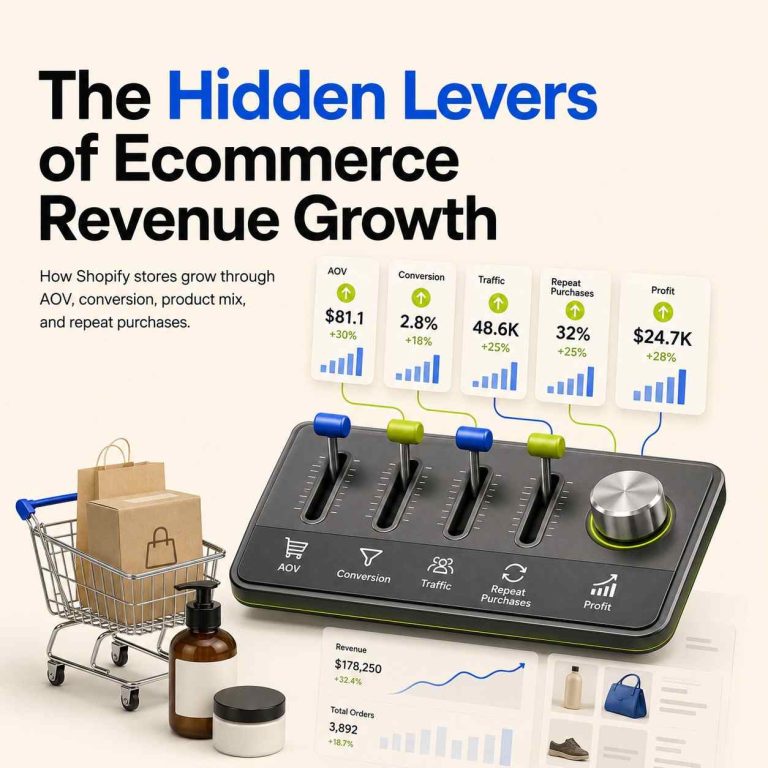
The Hidden Levers of Ecommerce Revenue Growth
Ecommerce revenue growth does not come from traffic alone. Revenue is the result of several multiplying factors—how many qualified visitors arrive, how many buy, how much they spend, how often they return, and how much profit remains after fulfilling those orders.
For Shopify merchants, this means some of the highest-leverage growth opportunities exist inside the buying experience rather than at the top of the funnel. Tools such as Adoric Bundles Quantity Breaks fit into this layer by helping merchants change order economics through quantity incentives, bundles, add-ons, and other structured offers instead of depending entirely on more acquisition.
Ecommerce Growth Is a Multiplication Problem
At the simplest level:
Revenue = Traffic × Conversion Rate × Average Order Value
If a store receives 100,000 monthly sessions, converts 2% of them, and generates a $60 average order value:
100,000 × 2% × $60 = $120,000 in revenue
Most growth teams instinctively focus on the first number.
Get more traffic.
Launch another campaign.
Increase the advertising budget.
Find another acquisition channel.
But traffic is only one multiplier. Increasing either of the other two variables can grow revenue from exactly the same audience.
For example, if conversion rises from 2% to 2.2% while AOV increases from $60 to $66:
100,000 × 2.2% × $66 = $145,200
That is 21% more revenue without increasing traffic.
This is why ecommerce growth should be treated as a system of connected levers rather than an acquisition problem. For a deeper look specifically at the economics behind order size, see The Economics of Average Order Value in Ecommerce (Shopify Guide).
Lever #1: Revenue Per Visitor
A useful way to look at store performance is revenue per visitor, or RPV.
The formula is:
Revenue Per Visitor = Conversion Rate × Average Order Value
If your conversion rate is 2% and AOV is $60:
0.02 × $60 = $1.20 revenue per visitor
This number tells you how effectively the store monetizes the traffic it already receives.
That makes RPV especially useful when acquisition costs rise. If every visitor becomes more expensive but each visitor still produces the same amount of revenue, your margins get squeezed even if topline sales continue growing.
Why this matters more than traffic in isolation
Imagine two Shopify stores.
| Metric | Store A | Store B |
|---|---|---|
| Monthly sessions | 100,000 | 75,000 |
| Conversion rate | 1.8% | 2.4% |
| AOV | $50 | $70 |
| Monthly revenue | $90,000 | $126,000 |
| Revenue per visitor | $0.90 | $1.68 |
Store A has significantly more traffic.
Store B makes significantly more money.
This is the hidden problem with using traffic as the headline growth metric: traffic measures attention, not the economic value created from that attention.
Before paying to bring another 20,000 people into the store, it is worth asking whether the existing 100,000 visitors are being monetized effectively.
Adoric explores this idea more deeply in How Shopify Stores Can Increase Revenue Per Visitor Without More Traffic.
Lever #2: The Number of Units Customers Buy
AOV is often discussed as though the only way to increase it is to convince customers to buy more expensive products.
That is only one path.
For many Shopify stores, increasing units per transaction is easier.
A shopper purchasing one $25 skincare product does not necessarily want a $50 alternative. But they may reasonably buy two bottles if the product is replenishable and the offer makes the additional quantity worthwhile.
The buying decision changes from:
“Should I buy this?”
to:
“How many should I buy?”
That distinction matters.
The merchant no longer has to create demand for another product. The customer has already decided that the product has value. The remaining job is to make a larger quantity economically and practically sensible.
Consumables are the obvious example
Suppose a skincare brand sells cleanser for $28.
Instead of showing only:
1 cleanser — $28
the product page could offer:
- 1 for $28
- 2 for $52
- 3 for $72
The customer can immediately understand the trade-off between spending more now and receiving better value per unit.
This structure is what quantity breaks are designed to accomplish. Adoric Bundles Quantity Breaks can be used to build these choices directly into the buying experience rather than relying on shoppers to discover a discount later.
But quantity breaks are not universal
Selling more units only works when owning more units makes sense.
It can be effective for:
- skincare
- supplements
- coffee
- pet products
- socks
- basic apparel
- household goods
- office supplies
- B2B-lite products
It is less natural for products customers rarely need multiples of, such as an expensive sofa, laptop, or specialized appliance.
The mechanism should follow the buying behavior—not the other way around.
Lever #3: Offer Architecture
Two stores can sell exactly the same products at exactly the same prices and generate different AOVs because of how those products are presented.
This is offer architecture.
A conventional product page might ask:
Do you want to buy this product?
A structured offer asks:
Which buying option makes the most sense for you?
That is a fundamentally different decision.
Quantity breaks expand an existing purchase
Quantity breaks work particularly well when customers naturally consume or use multiple units.
For example:
Buy 1 — Standard price
Buy 2 — Save 10%
Buy 3 — Save 15%
The important part is not simply the discount.
It is the creation of a visible purchasing ladder.
Customers now have reference points. Instead of evaluating the product against zero, they are comparing three ways of buying it.
Bundles expand the use case
Bundles solve a different problem.
Instead of encouraging more of the same item, they combine products that make more sense together.
An apparel store might combine:
- shirt
- trousers
- belt
A skincare store could combine:
- cleanser
- serum
- moisturizer
A coffee merchant might combine:
- beans
- filters
- brewing accessory
The customer is not simply buying more. They are buying a more complete solution.
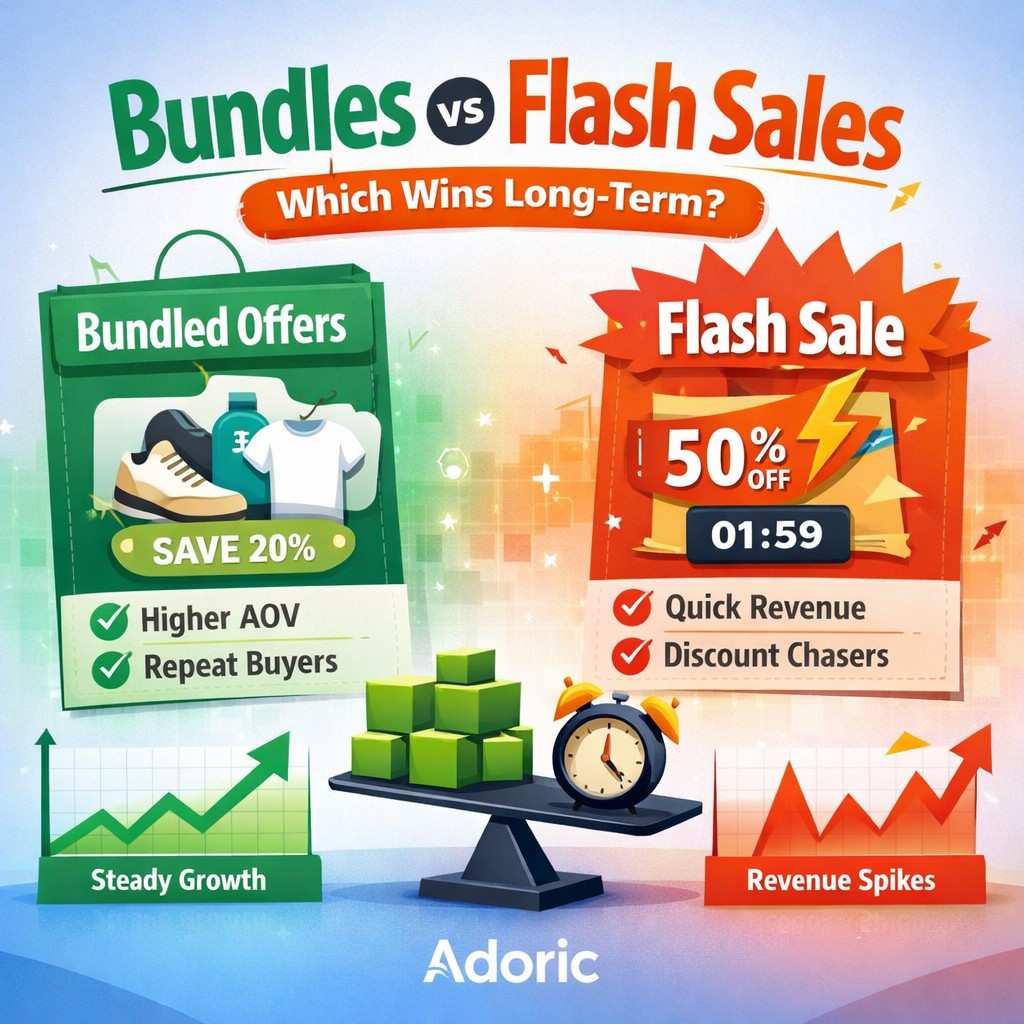
This distinction matters enough that Shopify merchants should not automatically choose one approach over the other. Quantity Breaks vs Bundles: Which Drives Higher AOV? explains where each structure tends to fit.
Add-ons capture secondary intent
There is also a smaller but useful lever between bundles and traditional upselling: the relevant add-on.
Consider a customer purchasing a $120 leather bag.
Trying to convince them to buy two bags may be unrealistic. Offering a $15 care product, personalization option, or matching accessory requires a much smaller additional decision.
The best add-ons have three characteristics:
- They are clearly related to the primary purchase.
- Their price is relatively small compared with the main product.
- The customer immediately understands why they might need them.
This is why random cross-selling usually underperforms contextual cross-selling.
Lever #4: The Threshold Where Spending More Becomes Rational
A discount is not automatically an AOV strategy.
The threshold matters.
Suppose most customers naturally purchase two units of a product. If you offer a discount starting at two, you may simply discount behavior that would have happened anyway.
You increased the discount rate.
You did not necessarily increase the order.
The better question is:
What behavior do we want the incentive to change?
If typical customers purchase one unit, a two-unit threshold may make sense.
If typical customers already purchase two, perhaps the meaningful threshold is three.
The same principle applies to free shipping.
If AOV is currently $68, setting free shipping at $70 probably subsidizes many orders that would already have reached that amount.
A threshold at $80 or $85 may create more incremental spending—but only if customers can realistically bridge the gap.
Thresholds need an attainable next step
This is one reason progress-based incentives work better when the remaining gap feels actionable.
“Spend another $9 to unlock free shipping” gives the shopper a solvable problem.
“Spend another $73” probably does not.
The incentive should sit just beyond existing behavior, not miles beyond it.
Lever #5: The Economics Behind the Discount
Merchants sometimes reject quantity discounts because they see only the reduction in unit price.
But profitable growth depends on order economics, not the percentage discount in isolation.
Consider a simplified example.
A product sells for $30 and costs $10.50 to produce.
A one-unit order produces:
- Revenue: $30
- Product cost: $10.50
- Gross profit before other costs: $19.50
Now suppose the merchant offers two units with a 10% discount.
The customer pays $54.
The simplified economics become:
- Revenue: $54
- Product cost: $21
- Gross profit before other costs: $33
The merchant sacrificed some margin percentage but generated substantially more gross profit from that order.
That does not automatically make the offer profitable. Payment fees, fulfillment, shipping, returns, and acquisition cost still matter.
But it demonstrates why asking only, “How much discount are we giving away?” can be misleading.
The better question is:
What happens to contribution profit when order size changes?
Sometimes no discount is required
This is particularly important with bundles.
Customers may accept a bundle because it offers:
- convenience
- product discovery
- easier decision-making
- a complete solution
- exclusive packaging
- free shipping
- a small bonus product
The incentive does not always need to be a large percentage reduction.
A strong bundle changes perceived value before it changes price.
For more on constructing these offers around customer behavior, see How to Design Bundle Offers Customers Actually Want.
Lever #6: Decision Friction
Growth does not only come from adding incentives.
Sometimes the highest-leverage action is removing a decision.
Every ecommerce purchase requires the customer to answer questions:
- Is this right for me?
- Which variant should I choose?
- What size?
- How much do I need?
- Is this worth the price?
- Do these products work together?
- What happens if I choose incorrectly?
Each unanswered question creates friction.
This is why merchandising and conversion optimization are closely connected.
More choice can reduce revenue
Suppose a merchant creates seven quantity tiers:
1 unit
2 units
3 units
4 units
5 units
6 units
10 units
Technically, customers have more flexibility.
Practically, many customers now have more work.
For most consumer products, three clear options often communicate the value curve more effectively than forcing shoppers to calculate seven different possibilities.
The objective is not maximum configuration.
It is maximum clarity.
Apparel has a different friction problem
Consider a T-shirt brand.
“Buy 3 and save 15%” may sound attractive, but if customers cannot easily mix colors or sizes, the offer becomes less useful.
A shopper may want:
- 1 black, medium
- 1 white, medium
- 1 grey, large
The economics of the offer may be attractive while the mechanics are frustrating.
That is why bundle flexibility can matter as much as bundle pricing.
Lever #7: Product Mix
AOV can rise because customers purchase more items.
It can also rise because they purchase a better combination of items.
This is where product mix matters.
Suppose two $80 orders have identical revenue:
Order A
- $80 main product
Order B
- $60 main product
- $20 high-margin accessory
The orders have the same AOV.
They may have very different profitability.
This is why sophisticated AOV optimization looks beyond the cart total.
Merchants should ask:
- Which products are commonly purchased together?
- Which products have strong margins?
- Which accessories improve the core product experience?
- Which products are cheap to ship alongside an existing order?
- Which products lead to future repeat purchases?
The ideal cross-sell is not simply the product that increases revenue the most.
It is the product that improves the economics and usefulness of the order.
The Overlooked Lever: Purchase Frequency
AOV focuses on how much the customer spends today.
Purchase frequency asks how often they come back.
Both affect revenue.
Consider two customers:
Customer A
- $100 first order
- Never returns
Customer B
- $70 first order
- Makes three purchases annually
Customer B produces $210 in annual revenue.
This is why blindly maximizing first-order AOV can occasionally work against long-term growth.
A customer should not be pressured into purchasing six months of inventory if doing so creates:
- excessive discounting
- product fatigue
- poor cash perception
- a much longer replenishment cycle
For consumable brands in particular, there is a balance between increasing units per order and preserving a healthy reorder rhythm.
Bundles can improve future discovery
Bundles can also influence repeat behavior.
A skincare customer who purchases only moisturizer knows one product.
A customer who purchases a routine containing cleanser, serum, and moisturizer has now experienced three products.
That creates more potential paths for the next purchase.
This is one reason bundling can have value beyond immediate AOV when the products are genuinely complementary.
The Most Important Lever Is Often Interaction Between Levers
The biggest mistake is optimizing these metrics independently.
Increasing AOV while destroying conversion is not necessarily growth.
Increasing conversion by discounting everything is not necessarily growth.
Increasing order frequency while paying an unsustainable acquisition cost is not necessarily growth.
The levers interact.
A simplified model looks like this:
Revenue = Traffic × Conversion Rate × AOV
Over a longer customer relationship:
Customer Revenue = Average Order Value × Purchase Frequency
And ultimately:
Profitable Growth = Revenue Growth + Healthy Contribution Economics
The objective is therefore not to maximize one metric.
It is to improve the overall system.
How the Levers Differ by Shopify Business Model
There is no universal ecommerce growth playbook because buying behavior changes by category.
Apparel
For apparel, useful levers often include:
- mix-and-match quantity offers
- outfit bundles
- complementary accessories
- free-shipping thresholds
- clear sizing and variant selection
Quantity discounts can work well for basics such as T-shirts, socks, underwear, or activewear.
They may be less persuasive for statement pieces customers typically buy individually.
Consumables
Consumables are naturally suited to unit expansion.
Examples include:
- skincare
- supplements
- coffee
- pet food
- household products
A 1/2/3-unit quantity structure can make sense because customers know they will eventually use the additional inventory.
The primary constraint is discount economics and how much inventory customers realistically want to hold.
B2B-Lite Ecommerce
Many Shopify stores sit somewhere between consumer retail and wholesale.
Think:
- packaging supplies
- café consumables
- professional beauty products
- cleaning supplies
- studio equipment
- office products
These merchants may benefit from larger quantity breaks because purchasing multiples is operationally normal.
For a consumer, buying 20 units may look absurd.
For a small business, it may be the default order.
High-Ticket Products
Quantity incentives become less important as the natural purchase frequency of the primary product falls.
A furniture merchant probably should not build its growth strategy around convincing people to buy three sofas.
The opportunity may instead be:
sofa → cushions → protection product → side table
The principle remains the same—expand the transaction—but the mechanism changes.
How to Decide Which Revenue Lever to Work on First
Start with the weakest part of the revenue equation.
If traffic is strong but revenue is weak
Look at:
- conversion rate
- revenue per visitor
- product-page friction
- merchandising
- AOV
Do not immediately buy more traffic.
If conversion is healthy but orders are small
Look at:
- quantity breaks
- bundles
- add-ons
- product recommendations
- free-shipping thresholds
- product mix
This is the situation where AOV optimization usually deserves more attention.
If AOV is high but customers rarely return
Investigate:
- product satisfaction
- replenishment cycles
- retention
- customer experience
- merchandising after the first purchase
Increasing the first order even further may not solve the actual problem.
If revenue is increasing but profit is not
Review:
- discount depth
- shipping subsidies
- returns
- acquisition costs
- product mix
- contribution margin
Revenue growth and business growth are not always the same thing.
A Practical Shopify Growth Diagnostic
Before changing your strategy, look at the last 60–90 days and record:
- Sessions
- Conversion rate
- Revenue per visitor
- Average order value
- Units per order
- Product attach rate
- Repeat purchase rate
- Discount rate
- Gross or contribution margin
- Customer acquisition cost
Then ask three questions.
1. Where is customer intent being lost?
If shoppers reach product pages but do not purchase, AOV tactics may not be the first priority.
The conversion problem needs attention.
2. Where is existing intent being under-monetized?
If customers readily purchase one item but rarely add another, there may be an opportunity for:
- quantity breaks
- bundles
- complementary products
- better thresholds
This is where systems such as Adoric Bundles Quantity Breaks become useful: not because every store needs another discount, but because merchants need a practical way to test different order structures.
3. Which improvement would produce incremental profit?
Do not stop the analysis at revenue.
Estimate what happens to:
- COGS
- fulfillment
- shipping
- discount cost
- payment fees
- returns
AOV growth is valuable when the additional order value creates worthwhile incremental economics.
Common Mistakes When Trying to Grow Ecommerce Revenue
Buying More Traffic Before Fixing Store Economics
More traffic multiplies whatever already exists.
If conversion is poor and order sizes are weak, sending more visitors into the same experience may simply scale inefficiency.
Fixing monetization before increasing acquisition can make the next dollar spent on traffic more productive.
Treating Every Product the Same
A quantity offer that works for coffee may fail for jewelry.
A bundle that works for skincare may feel forced for furniture.
The purchase model should determine the offer structure.
Discounting Existing Behavior
If customers already buy two units, giving every two-unit order a discount may reduce margin without changing behavior.
Incentives should encourage the next desirable action.
Using Bigger Discounts Instead of Better Offers
A weak bundle does not necessarily need another 10% off.
It may need:
- better product pairing
- clearer value
- a more useful quantity
- stronger placement
- fewer options
Discount depth is only one variable.
Optimizing AOV Without Watching Conversion
AOV can rise because fewer low-spending customers complete purchases.
That is not necessarily a win.
Always analyze AOV alongside conversion rate and revenue per visitor.
Confusing Revenue With Profit
A $150 order is not automatically better than a $120 order if the additional $30 requires $35 in discounts, shipping, fulfillment, or product cost.
The goal is economically productive revenue.
What Sustainable Ecommerce Revenue Growth Actually Looks Like
Sustainable ecommerce growth is rarely created by one dramatic optimization.
It tends to come from several improvements that compound.
A merchant might:
- slightly improve conversion
- move some one-unit buyers to two units
- increase complementary-product attachment
- improve repeat purchasing
- reduce unnecessary discounting
Each individual change may appear modest.
Together, they can materially change how much revenue and profit the same customer base produces.
That is the key shift in thinking.
Instead of asking only:
“How can we get more customers?”
Ask:
“How much economic value are we creating from the customers and purchase intent we already have?”
That question exposes the hidden levers.
FAQ
What are the main levers of ecommerce revenue growth?
The main ecommerce revenue levers are traffic, conversion rate, average order value, units per order, product mix, purchase frequency, and margin. These variables interact, so sustainable growth usually comes from improving several rather than maximizing one in isolation.
How can an ecommerce store grow revenue without more traffic?
A store can grow without increasing traffic by improving conversion rate and revenue per visitor, increasing AOV through bundles or quantity breaks, increasing units per transaction, improving cross-sells, and generating more repeat purchases.
For Shopify stores with healthy conversion but relatively small orders, changing offer structure can be particularly effective because it monetizes purchase intent that already exists.
Is increasing AOV or conversion rate more important?
Neither is universally more important.
If many qualified visitors reach product pages but do not purchase, conversion is likely the larger constraint. If customers already convert reliably but purchase only one low-value item, increasing AOV may offer more leverage.
Revenue per visitor helps merchants evaluate both metrics together.
Do bundles and quantity breaks always increase AOV?
No.
Quantity breaks work best when customers have a logical reason to purchase multiple units, while bundles work best when products naturally complement each other.
Poor product pairing, excessive complexity, unrealistic quantities, or weak value can cause either tactic to underperform.
How do you know if ecommerce revenue growth is profitable?
Look beyond revenue and calculate the incremental economics of the additional sales.
Consider product cost, discounts, fulfillment, shipping, payment fees, returns, and customer acquisition cost. Revenue growth is attractive when additional orders produce enough contribution profit to justify the incentives required to generate them.
What should a Shopify merchant optimize first?
Identify the largest constraint in the current revenue equation.
If traffic is insufficient, acquisition may deserve attention. If traffic is healthy but conversion is weak, remove purchase friction. If conversion is healthy but order size is low, investigate bundles, quantity breaks, add-ons, and other AOV mechanisms.
The right starting point is not the tactic currently getting the most attention in ecommerce. It is the part of your store’s economics with the most room to improve.
Final Thought
Before increasing your next acquisition budget, take one of your highest-volume products and map what happens after a shopper decides they want it.
Do they have a natural reason to buy two? Is there another product that completes the purchase? Is the next spending threshold clear and attainable? And most importantly: are you giving existing customers a logical reason to create a larger, more profitable order?