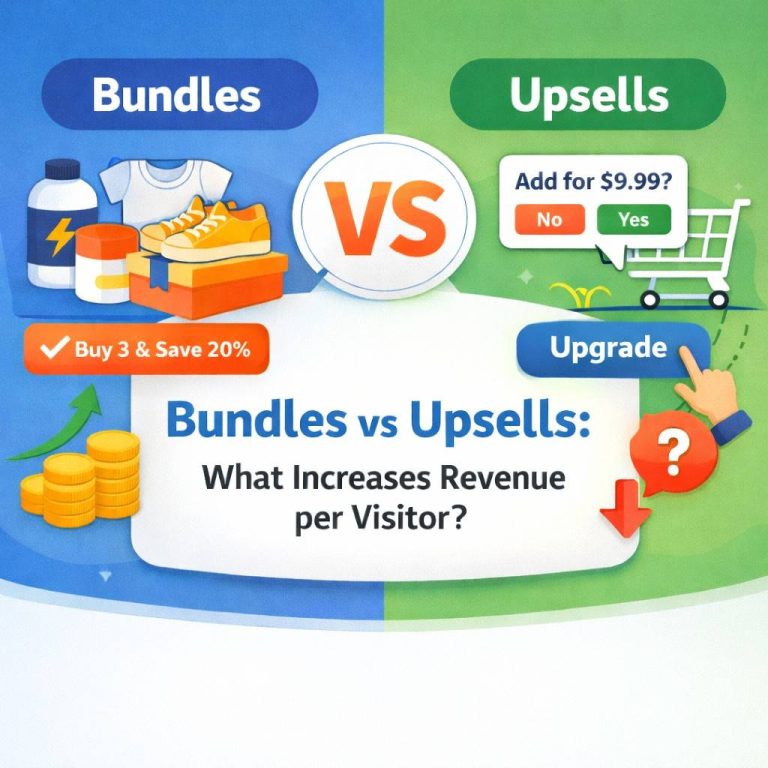
Bundles generally increase revenue per visitor more consistently than upsells because they influence the buying decision before checkout, not after. Upsells can add incremental revenue, but bundles—especially quantity-based bundles—tend to drive higher average order value with less friction and lower drop-off.
Why This Comparison Matters More Than Ever
Most Shopify merchants reach a point where traffic growth slows, costs rise, and revenue plateaus. At that stage, increasing revenue per visitor becomes more important than acquiring more visitors.
This is where merchants usually ask:
- Should we add upsells?
- Should we create bundles?
- Or should we do both?
The problem is that upsells and bundles work on different psychological moments in the buying journey. Treating them as interchangeable leads to underwhelming results.
What Bundles and Upsells Actually Do (Mechanically)
What a Bundle Does
A bundle changes the initial purchase decision. It reframes the offer so the customer evaluates multiple items or quantities as a single, higher-value choice.
Examples:
- Buy 2, save 10%
- Buy 3, save more
- Starter kits or multi-product sets
This approach increases AOV without requiring a second “yes.”
This is the core strategy behind Adoric Bundles Quantity Breaks, which focuses on showing bundle and quantity logic directly on the product page, before checkout friction exists.
What an Upsell Does
An upsell asks for an additional decision after the customer has already committed to buying.
Examples:
- “Add this for $9.99”
- “Upgrade to premium”
- Post-add-to-cart recommendations
Upsells rely on momentum, but they also introduce a new choice—one that can be ignored or declined.
Bundles vs Upsells: Revenue per Visitor Breakdown
Bundles: Higher Impact, Earlier
Bundles typically:
- Increase AOV more predictably
- Maintain or improve conversion rate
- Feel like value, not persuasion
Because the bundle is part of the main offer, customers don’t feel interrupted. In categories like apparel, supplements, beauty, and B2B-lite ecommerce, bundle-based pricing often becomes the default buying path.
This is especially true with quantity breaks, where customers naturally expect better pricing for buying more.
Upsells: Incremental, but Fragile
Upsells can work well when:
- The add-on is obviously complementary
- The price gap is small
- The customer is already confident
However, upsells often:
- Have lower acceptance rates
- Depend heavily on timing and UX
- Stop performing once customers get used to them
They add revenue at the margins, but they rarely transform revenue per visitor on their own.
Where Bundles Clearly Outperform Upsells
Bundles usually win when:
- Products are repeat-purchase or consumable
- Customers buy more than one unit naturally
- Margins support volume incentives
- You want predictable AOV growth
Example scenarios:
- Apparel basics (buy 2–3 items)
- Supplements (monthly supply bundles)
- Beauty routines (multi-step sets)
- Office or B2B-lite products (tiered pricing)
In these cases, bundles remove decision fatigue rather than adding to it.
When Upsells Still Make Sense
Upsells are useful when:
- The add-on is optional, not essential
- Bundling would feel forced
- You want to test incremental revenue quickly
They work best as supporting tactics, not the primary growth lever.
This is why high-performing Shopify stores usually treat upsells as secondary to their main pricing and bundle strategy.
The Role of Quantity Breaks (The Overlooked Middle Ground)
Quantity breaks sit between bundles and upsells.
They:
- Preserve simplicity
- Reward higher quantity
- Don’t require extra products
- Scale cleanly across catalogs
This is why many merchants move from upsells to quantity-based bundles over time. Quantity breaks combine the strength of bundles with the simplicity of single-product offers.
This is also where Adoric Bundles Quantity Breaks fits naturally—enabling bundles and quantity logic without complicating inventory or checkout.
For comparison against discount-heavy approaches, see:
Why Most Shopify Discounts Hurt Profit More Than They Help
Common Mistakes Merchants Make
- Relying on upsells to fix low AOV
- Introducing upsells too late in the funnel
- Creating bundles that feel arbitrary
- Overloading product pages with offers
- Treating bundles as promotions instead of pricing logic
Most failures come from using the right tactic at the wrong moment.
Can Bundles and Upsells Work Together?
Yes—but with a clear hierarchy.
High-performing stores usually:
- Use bundles or quantity breaks as the primary offer
- Use upsells selectively for accessories or extensions
- Avoid stacking too many incentives at once
Bundles lead. Upsells support.
Frequently Asked Questions
Are bundles better than upsells for increasing AOV?
In most cases, yes. Bundles affect the initial purchase decision, which makes them more reliable for AOV growth.
Do upsells hurt conversion rates?
They can, especially if poorly timed or visually intrusive.
Can bundles and upsells be used together?
Yes, but bundles should be the primary strategy, with upsells as secondary enhancements.
What products work best with bundles?
Consumables, apparel basics, beauty, supplements, and B2B-lite products perform especially well.
How do quantity breaks compare to upsells?
Quantity breaks usually outperform upsells for revenue per visitor because they feel like pricing logic, not persuasion.
Final Thoughts
If your goal is to increase revenue per visitor, the question isn’t bundles or upsells. It’s which decision moment you want to influence.
Bundles—and especially quantity-based bundles—work earlier, more naturally, and more consistently. Upsells still have a role, but they rarely carry the strategy on their own.