
Average Order Value (AOV) is one of the most efficient growth levers in ecommerce because it increases revenue without increasing acquisition cost. The most effective way to improve AOV is by changing purchase behavior at the point of decision—through bundles, quantity breaks, and reward-based incentives like those enabled by tools such as Adoric Bundles Quantity Breaks.
Why AOV Is an Economic Lever, Not Just a Metric
Most Shopify merchants treat AOV as a KPI to track. In reality, it’s a unit economics lever that directly impacts profitability.
If your AOV increases from $50 to $65 while your cost per acquisition (CPA) stays the same, your contribution margin expands instantly. You are extracting more value from the same traffic, which is fundamentally more scalable than trying to lower CPA.
The key insight:
👉 AOV improvements compound with every order, while acquisition improvements are harder to scale.
The Hidden Math Behind AOV Growth
At a basic level:
Revenue = Traffic × Conversion Rate × AOV
Most teams focus on traffic and conversion rate. But AOV is often the least optimized variable, even though it’s the easiest to influence inside the buying journey.
What makes AOV unique:
- It’s controlled on-site, not dependent on external platforms
- It responds quickly to UX and pricing changes
- It scales across all traffic sources
This is why experienced operators prioritize AOV once a store reaches stable traffic.
Behavioral Economics: Why Customers Add More
Increasing AOV is not about forcing bigger purchases. It’s about aligning with how people naturally make decisions.
1. Progress Bias
Customers are more likely to complete a goal when they feel close to it.
Example: “You’re $10 away from free shipping.”
2. Perceived Value Gain
Bundles and quantity breaks shift focus from price to value.
Instead of “spend more,” the message becomes “get more for slightly more.”
3. Loss Aversion
Customers don’t want to “miss” a deal they’re close to unlocking.
This is where mechanisms like rewards progress become powerful. When customers see how close they are to a reward, they’re more likely to increase cart size naturally.
Bundles and Quantity Breaks as Economic Tools
Bundles and quantity breaks are not just UX features—they are pricing strategies.
Platforms like Adoric Bundles Quantity Breaks operationalize these strategies directly inside the storefront, allowing merchants to shape how customers build their carts.
Why They Work Economically
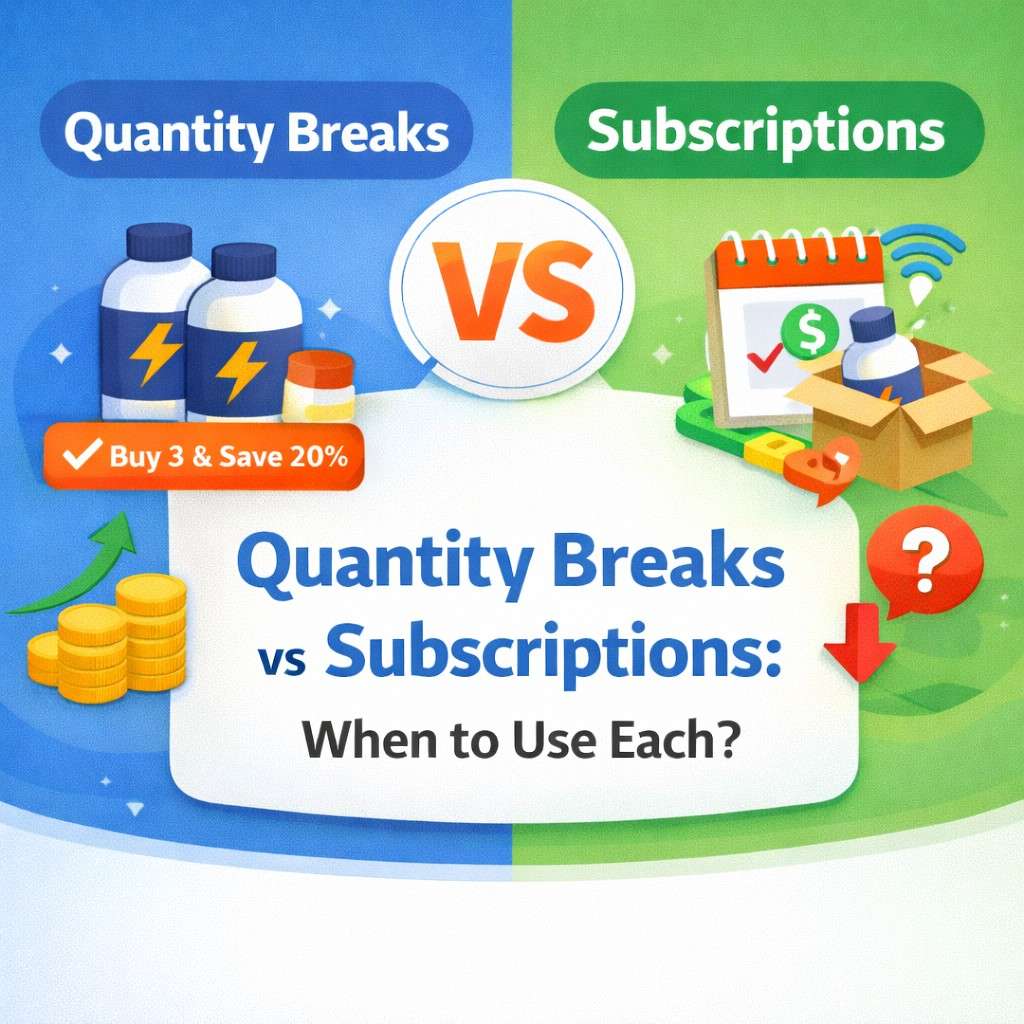
- They increase items per order, not just price per item
- They reduce price sensitivity by reframing value
- They shift decisions from “Should I buy?” to “How much should I buy?”
Example: Apparel Store
Instead of selling a t-shirt for $30:
- Buy 1 → $30
- Buy 2 → $55
- Buy 3 → $75
The marginal cost of producing the extra unit is lower than the perceived discount, so profit still increases.
Example: Consumables (Skincare, Supplements)
Customers already expect repeat purchases. Quantity breaks accelerate that behavior into a single transaction.
Marginal Revenue vs Marginal Cost
The real goal of AOV optimization is not just higher revenue—it’s higher profit per order.
When a customer adds one more item:
- Marginal revenue = full selling price
- Marginal cost = production + fulfillment
If your margins are healthy, each additional item significantly increases profitability.
This is why AOV strategies are especially powerful in:
- Private label brands
- High-margin products
- Lightweight items (low shipping cost impact)
The Trade-Off: AOV vs Conversion Rate
Not every AOV increase is good.
If your incentives are too aggressive or confusing, you may:
- Slow down decision-making
- Reduce conversion rate
- Create friction in checkout
The balance is critical:
- Small AOV increase + stable conversion rate = ideal
- Large AOV increase + conversion drop = risky
In practice, the best-performing stores use:
- Simple thresholds
- Clear messaging
- Minimal cognitive load
Real Shopify Patterns That Work
1. “Almost There” Thresholds
“You’re $15 away from free shipping” consistently outperforms static discounts because it activates progress bias.
2. Tiered Quantity Breaks
Increasing incentives at each level (2 → 3 → 4 items) creates a natural escalation path.
3. Mix & Match Bundles
Letting customers choose products removes friction while preserving bundle economics.
👉 (Suggested internal article: “Mix & Match Bundles on Shopify” — create if not yet published)
4. Cart-Level Rewards
Instead of discounting individual products, reward the total cart value.
Common Mistakes
Overcomplicating Offers
Too many tiers or conditions create decision fatigue. Simplicity wins.
Discounting Too Early
If you offer a discount at low thresholds, you reduce margin without increasing order size.
Ignoring Product Type
What works for apparel may fail for high-ticket electronics. AOV strategies must match buying behavior.
Treating AOV in Isolation
AOV should always be analyzed alongside:
- Conversion rate
- Contribution margin
- Customer lifetime value
How This Fits Into a Modern Shopify Stack
In 2026, AOV is not optimized manually—it’s embedded into the shopping experience.
Tools like Adoric Bundles Quantity Breaks allow merchants to:
- Create dynamic quantity incentives
- Show real-time progress toward rewards
- Test different pricing structures quickly
This shifts AOV optimization from a one-time setup to an ongoing system.
For a deeper breakdown of implementation strategies, see:
👉 How to create a bundle that customer want
FAQ
What is a good AOV for Shopify stores?
It depends on your product category, but what matters more is whether your AOV supports profitable acquisition.
Does increasing AOV hurt conversion rate?
It can, if the offer is complex or aggressive. The goal is incremental, frictionless increases.
Are bundles better than discounts for AOV?
Yes, in most cases. Bundles increase perceived value instead of reducing price.
How do quantity breaks affect profitability?
They increase items per order, often improving margins if structured correctly.
When should you prioritize AOV over traffic growth?
When your traffic is stable but margins are tight, AOV is usually the highest-leverage next step.