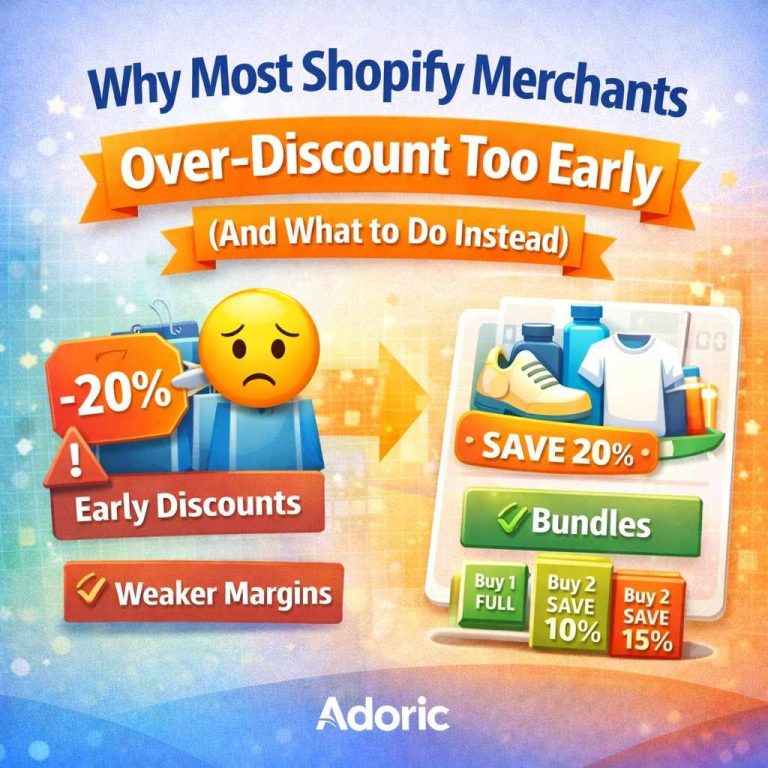
Many Shopify merchants start discounting too early because it feels like the fastest way to increase sales. But early discounting often hides deeper issues such as weak AOV, unclear product value, or poor merchandising. Instead of lowering prices immediately, strategies like bundles and quantity breaks—often implemented through tools like Adoric Bundles Quantity Breaks—can increase order value while preserving margins.
Discounts are easy.
That’s exactly why they’re dangerous.
Why Discounts Feel Like the Quickest Fix
When sales slow down, the instinctive reaction is simple:
“Let’s run a sale.”
Discounts often produce immediate results:
- Conversion rate increases
- Traffic campaigns perform better
- Revenue temporarily spikes
But these short-term gains can create long-term problems.
Because discounts change customer expectations.
The Hidden Cost of Early Discounting
Discounts rarely exist in isolation.
Once customers see frequent promotions, they begin to anticipate them.
This creates a new purchase pattern:
Customers stop asking:
“Do I want this product?”
Instead, they start asking:
“When will the next discount happen?”
Over time this leads to:
- Lower full-price conversions
- Margin compression
- Customers waiting for promotions
The store becomes dependent on sales events to generate revenue.
Discounts Often Hide the Real Problem
Early discounting frequently masks deeper issues in the buying experience.
Common underlying problems include:
- Low average order value
- Weak product positioning
- Poor bundle structure
- Missing cross-sell opportunities
Discounts increase conversion rate but do nothing to improve purchase depth.
A customer who buys a discounted single item still produces a small order.
For a deeper look at revenue mechanics, see our guide How to Increase Average Order Value on Shopify.
The Better Alternative: Increase Order Value
Instead of reducing price, many successful Shopify stores focus on increasing cart size.
This changes the economics of every transaction.
Example:
Product price: $30
Customer buys one item → $30 order
Customer buys three items → $90 order
The second scenario produces significantly more revenue without increasing traffic or lowering price.
Bundles and quantity breaks help achieve this.
How Bundles Solve the Discount Problem
Bundles encourage customers to purchase multiple products together.
Example:
Skincare routine bundle
- Cleanser
- Toner
- Moisturizer
Customers perceive this as a complete solution rather than a discount.
Bundles increase AOV while maintaining perceived product value.
Our article How to Design Bundle Offers Customers Actually Want explains the psychology behind successful bundle structures.
Quantity Breaks: “Buy More, Save More”
Quantity breaks provide a structured alternative to sitewide discounts.
Example:
Buy 1 → Full price
Buy 2 → Save 10%
Buy 3 → Save 15%
This model rewards larger purchases instead of discounting every order.
Many Shopify merchants implement tiered offers through Adoric Bundles Quantity Breaks, which embeds the structure directly on the product page near the purchase decision.
Customers see the incentive before completing checkout.
Real Shopify Examples
Apparel Brand
Instead of running 20% sitewide discounts, the brand launched:
Buy 2 T-shirts → Save 12%
Customers began purchasing multiple items instead of waiting for sales.
Coffee Brand
Price per bag: $16
Offer:
Buy 2 → Save 10%
Buy 3 → Save 15%
Customers began purchasing multiple bags at once.
Average order value increased significantly.
Skincare Brand
Instead of discounting individual products, the store introduced routine bundles.
Customers purchased the entire skincare system rather than a single item.
When Discounts Actually Make Sense
Discounts are not inherently bad.
They simply need to be used strategically.
Appropriate scenarios include:
- Clearing seasonal inventory
- Major shopping events (Black Friday, Cyber Monday)
- Product launches
- Reactivating inactive customers
In these cases, discounts act as tactical tools, not permanent strategy.
Common Mistakes Merchants Make
- Launching discounts before testing bundle offers
- Running sitewide discounts too frequently
- Using discounts to fix low AOV
- Conditioning customers to wait for promotions
- Ignoring margin impact when scaling ads
Discounts should support a strategy.
They shouldn’t replace one.
The Real Growth Lever: Purchase Depth
Ecommerce growth doesn’t always come from more traffic or higher conversion.
Often, it comes from increasing how much each customer buys.
Bundles, quantity breaks, and product sets help customers purchase multiple items naturally.
When implemented well, these strategies increase revenue without constantly lowering price.
FAQ
Why do Shopify merchants discount too early?
Discounting feels like the fastest way to increase sales, but it often masks deeper issues like low AOV or weak merchandising.
Do discounts hurt brand value?
Frequent discounts can reduce perceived value and train customers to wait for promotions.
What’s a better alternative to sitewide discounts?
Bundles and quantity breaks increase order value without lowering prices across the entire catalog.
When should a Shopify store run discounts?
During major events, inventory clearance, or customer reactivation campaigns.
How can bundles increase sales without discounting?
Bundles encourage customers to purchase multiple related products, increasing the total order value.
Discounts solve short-term problems.
But sustainable ecommerce growth usually comes from better purchasing structures, not lower prices.
So the next time sales slow down, the real question might not be:
“Should we run a discount?”
It might be:
“Are we giving customers a reason to buy more than one product?”