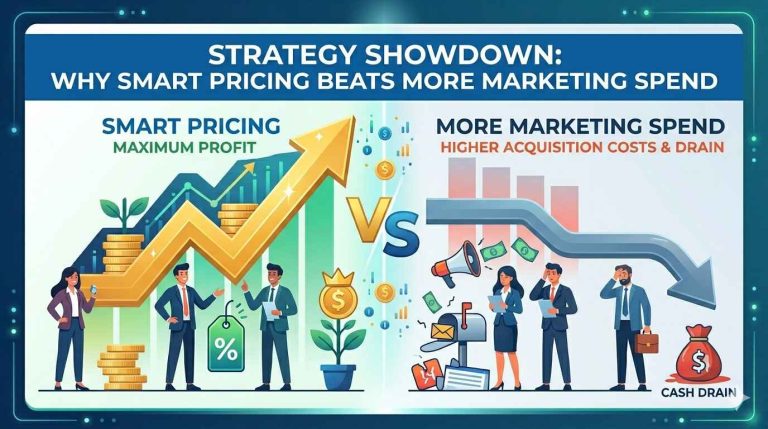
Smart pricing increases revenue by improving how much each customer spends, while marketing increases how many customers you acquire. Shopify stores that optimize pricing—through bundles, quantity breaks, and structured offers—often grow faster and more profitably than those relying primarily on increased marketing spend.
Growth is not just about reaching more people. It’s about getting more value from each person you already reach.
The Default Growth Trap: Spend More to Grow More
When growth slows, the instinct is usually to increase marketing spend.
Run more ads. Test more creatives. Expand to new channels.
In the short term, this works. More traffic leads to more sales.
But over time, two things happen:
- acquisition costs increase
- returns begin to decline
This creates a ceiling. Growth becomes more expensive, not more efficient.
The Overlooked Lever: Revenue Per Visitor
Every Shopify store has another growth lever that is often underused: revenue per visitor.
Instead of focusing only on:
- how many people visit
high-performing stores focus on:
- how much value each visitor generates
This shift changes everything.
Improving revenue per visitor:
- increases profitability
- reduces reliance on paid traffic
- makes every marketing channel more effective
Why Pricing Has a Compounding Effect
Marketing impacts the top of the funnel. Pricing impacts the entire system.
When pricing improves:
- AOV increases
- margins improve
- marketing ROI increases
This means that a single pricing improvement affects:
- paid ads
- organic traffic
- email campaigns
- retention
Unlike traffic, which scales linearly, pricing improvements compound across all channels.
Bundles and Quantity Breaks Are Pricing, Not Promotions
Many merchants think of bundles as a marketing tactic.
In reality, they are a pricing strategy.
Bundles and quantity breaks:
- change how value is perceived
- guide customers toward higher-value decisions
- increase order size without lowering price
This is why structured pricing systems—like those enabled by Adoric Bundles Quantity Breaks—are so effective. They allow stores to present multiple purchase options directly on the product page, making the best-value choice clear.
For a deeper breakdown of bundle design, see
How to Design Bundle Offers Customers Actually Want
Why More Traffic Can’t Fix Weak Pricing
If pricing structure is weak, increasing traffic amplifies inefficiencies.
Common symptoms include:
- strong traffic but low AOV
- high conversion but weak margins
- heavy reliance on discount codes
In these cases, more traffic increases revenue—but not profitability.
Pricing fixes the foundation. Marketing scales what’s already working.
The Relationship Between AOV and Marketing Efficiency
AOV directly influences how far your marketing can scale.
For example:
- Store A: $50 AOV
- Store B: $75 AOV
With the same conversion rate, Store B can spend significantly more on ads while remaining profitable.
This is why pricing strategy often determines:
- scalability
- profitability
- growth potential
For a broader perspective, see
Why Smart Merchants Focus on Revenue Per Visitor
Real Shopify Examples
Apparel Brand
Instead of increasing ad spend, the store introduced “buy 2 / buy 3” pricing tiers. AOV increased, making existing traffic more valuable.
Supplements Brand
Reframing the product as a 90-day bundle increased order size and reduced reliance on constant customer acquisition.
B2B-Lite Ecommerce
Tiered pricing aligned with buyer expectations, increasing order value without additional marketing investment.
When Marketing Still Matters More
There are situations where marketing should take priority:
- low traffic volume
- low brand awareness
- unclear product positioning
If customers are not discovering your product, pricing alone won’t solve the problem.
But once traffic is consistent, pricing often becomes the more powerful lever.
Common Mistakes Merchants Make
- scaling ads before optimizing AOV
- relying heavily on discounts
- ignoring pricing structure on product pages
- measuring success only by traffic or conversion rate
- treating pricing as static
These mistakes lead to growth that is expensive and difficult to sustain.
How to Know If Pricing Is Your Bottleneck
Pricing is likely limiting growth if:
- customers mostly buy one unit
- AOV is low relative to product type
- margins shrink as ad spend increases
- discounts are required to convert
These are signs that the purchase structure—not the traffic—is the issue.
How to Improve Pricing Before Scaling Marketing
To improve pricing effectiveness:
- introduce bundles or quantity tiers
- highlight best-value options
- simplify pricing structure
- align offers with natural buying behavior
- reduce reliance on discount codes
These changes increase the value of every visitor.
Frequently Asked Questions
Why is pricing more important than marketing in ecommerce?
Because pricing determines how much revenue each customer generates, affecting overall profitability.
How does pricing affect revenue per visitor?
It influences average order value, which directly impacts total revenue.
Do bundles increase marketing efficiency?
Yes, by increasing AOV, they make each visitor more valuable and improve ROI.
When should I focus on marketing instead of pricing?
When traffic is low or awareness is limited.
How can Shopify stores improve pricing strategy?
By structuring offers through bundles, quantity breaks, and clear value tiers.
Final Thoughts
Marketing brings customers in. Pricing determines how much value each customer creates.
Stores that rely only on marketing eventually hit limits. Stores that optimize pricing build a stronger foundation for growth.
Instead of asking “How do we get more traffic?”, a more effective question is:
“How can we make each visitor worth more?”
That shift is where efficient, scalable growth begins.