Most Shopify stores focus too heavily on acquiring more traffic when the bigger opportunity is increasing revenue from existing visitors. In practice, stores that improve average order value (AOV), purchase intent, and multi-product conversion often grow faster and more profitably than stores chasing incremental traffic gains.
For Shopify brands, increasing revenue per visitor usually comes down to improving monetization efficiency: helping customers buy more naturally, reducing friction during product discovery, and structuring offers around real buying behavior. This is why tools like Adoric Bundles Quantity Breaks have become increasingly common in modern Shopify stores — not because merchants want more “upsells,” but because they want better purchase flows.
Why Revenue Per Visitor Matters More Than Traffic
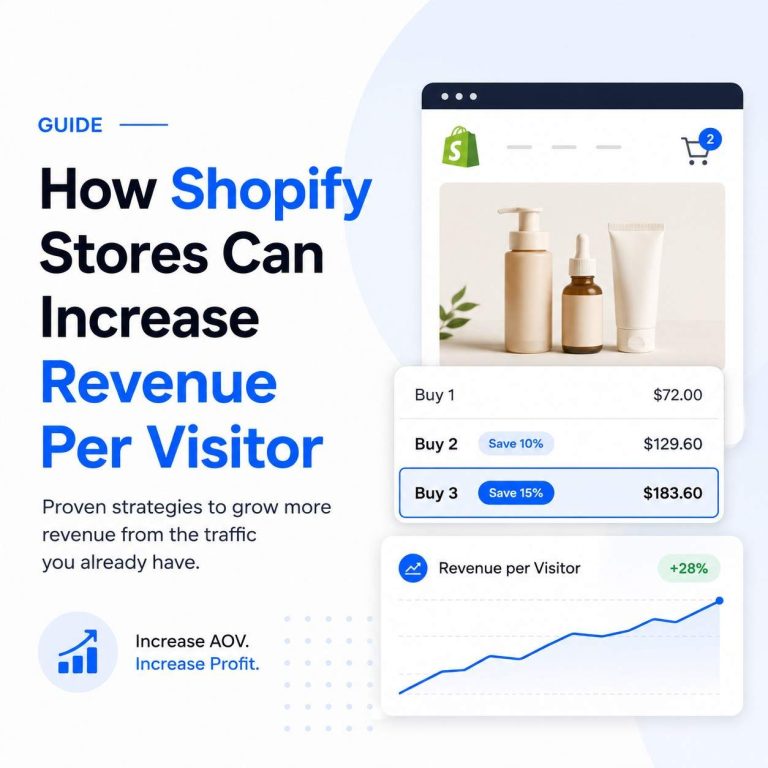
Revenue per visitor (RPV) measures how much revenue your store generates for every visitor that lands on your site.
A store with strong RPV can grow profitably even with flat traffic. A store with weak RPV becomes increasingly dependent on paid acquisition, discounts, and rising CAC tolerance.
This matters even more in 2026 because traffic acquisition has become less predictable. AI Overviews reduce clicks on informational queries, Meta CPMs fluctuate constantly, and Shopify merchants face more competition in nearly every category. Increasing monetization efficiency is often more controllable than scaling acquisition.
For example:
- A beauty brand increasing AOV from $48 to $62 may generate more profit than a 20% traffic increase.
- A consumables store encouraging 3-unit purchases instead of single-unit purchases can dramatically improve margins.
- A B2B-lite skincare wholesaler reducing friction for bulk purchasing may increase RPV without changing conversion rate at all.
In many cases, RPV optimization compounds faster than traffic growth.
Most Shopify Stores Under-Monetize Existing Intent
Many stores unintentionally optimize for the first purchase decision only.
The typical product page still looks like this:
- One product
- One CTA
- One quantity selector
- Minimal buying guidance
- No structured purchasing path
But customers rarely think in “single product” logic.
Beauty shoppers build routines. Supplement buyers stock up. Pet owners reorder. Fashion customers complete outfits. Even electronics buyers look for compatibility bundles and accessories.
The problem is not lack of purchase intent. The problem is lack of monetization structure.
This is why bundles and quantity breaks consistently outperform generic discounting strategies. Instead of reducing price randomly, they align with how people naturally buy.
For merchants exploring this approach, Adoric’s guide on creating Shopify product bundles is a useful foundational reference: How to Create Product Bundles on Shopify
The Fastest Way to Increase Revenue Per Visitor: Increase AOV
For most Shopify stores, increasing average order value is the fastest path to improving RPV.
Revenue=Traffic×Conversion Rate×AOVRevenue = Traffic \times Conversion\ Rate \times AOVRevenue=Traffic×Conversion Rate×AOV
If traffic stays flat but AOV rises, total revenue still increases.
This is why high-performing Shopify stores increasingly focus on:
- Bundled purchasing
- Quantity incentives
- Add-ons
- Multi-product recommendations
- Subscription layering
- Cart expansion moments
The important nuance is that these tactics work best when they feel behaviorally natural.
Example: Beauty Brands
A skincare customer buying cleanser, toner, and serum together does not feel “upsold.” They feel guided.
This is why skincare brands often see strong performance from:
- Routine bundles
- “Frequently bought together” blocks
- Mix-and-match kits
- Quantity breaks for replenishable items
The best implementations reduce decision fatigue instead of increasing it.
Example: Consumables
Coffee, supplements, protein powders, pet food, and household products often benefit from quantity breaks because the customer already expects repeat usage.
A “Buy 3 Save 15%” structure works because it aligns with inventory psychology:
- Fewer future purchases
- Better value perception
- Reduced reorder anxiety
Adoric Bundles Quantity Breaks is commonly used in these scenarios because Shopify merchants need flexible purchasing logic without duplicating products or breaking inventory structure.
Bundles Usually Work Better Than Sitewide Discounts
Many merchants try increasing RPV through aggressive discounting. This often increases conversion temporarily but compresses margins and trains customers to wait for promotions.
Bundles operate differently.
Instead of lowering perceived product value, bundles increase contextual value:
- “These products work together”
- “This routine is complete”
- “This quantity makes more sense”
- “This add-on improves the outcome”
That distinction matters psychologically.
For example:
- A 20% sitewide discount lowers price perception.
- A skincare routine bundle increases solution perception.
The second approach tends to be healthier long term.
This trade-off is one reason many merchants move from broad discounting into structured bundle systems over time.
Reduce Friction Around Multi-Product Purchasing
AOV optimization often fails because the UX becomes too complicated.
Common examples:
- Too many popups
- Aggressive upsells
- Confusing pricing logic
- Overwhelming bundle builders
- Cluttered cart experiences
Increasing revenue per visitor should not increase cognitive load.
The highest-performing Shopify experiences usually share three traits:
- Clear pricing logic
- Obvious value progression
- Minimal decision friction
This is why embedded quantity breaks often outperform modal upsells. The customer sees the incentive naturally during purchase evaluation instead of being interrupted later.
Similarly, inline add-ons often outperform post-cart offers because they maintain shopping momentum.
Where Revenue Per Visitor Optimization Usually Fails
1. Chasing Traffic Before Monetization
Many stores scale ads before fixing monetization efficiency. This increases dependency on acquisition instead of strengthening unit economics.
Improving RPV first often makes paid growth dramatically easier later.
2. Using Discounts Without Structure
Random discounts may increase short-term sales but can weaken long-term pricing power.
Structured offers tend to create healthier purchasing behavior.
3. Overcomplicating Bundles
Some stores build bundle systems that require too much effort from the customer.
The best bundles feel obvious.
4. Ignoring Mobile Purchase Behavior
Most Shopify traffic is mobile, but many bundle experiences are still desktop-first.
Complex bundle builders frequently underperform on mobile because they create friction at the exact moment customers want speed.
5. Treating AOV Tactics as Separate From UX
AOV optimization is not only about pricing strategy. It is a UX problem.
The structure, placement, timing, and clarity of offers matter as much as the discount itself.
The Stores That Win Usually Monetize Intent Better
The strongest Shopify stores in 2026 are not necessarily the stores with the most traffic.
They are often the stores that:
- Structure purchases intelligently
- Guide customers clearly
- Increase basket size naturally
- Reduce decision fatigue
- Align offers with real customer behavior
That is why RPV has become a more important operational metric than vanity traffic growth for many modern ecommerce teams.
Merchants who focus on monetization efficiency often discover they need less traffic growth than they originally assumed.
For additional context around long-term AOV strategy, Adoric’s article on the economics of average order value is also relevant: The Economics of Average Order Value in Ecommerce
FAQ
What is revenue per visitor in ecommerce?
Revenue per visitor (RPV) measures how much revenue a store generates for every site visitor. It combines conversion rate and average order value into a single monetization metric.
How do Shopify stores increase revenue without more traffic?
Most Shopify stores increase revenue without additional traffic by improving AOV, bundles, quantity breaks, cross-sells, subscriptions, and purchase flow efficiency.
What increases revenue per visitor the fastest?
For many ecommerce stores, increasing average order value through bundles and quantity incentives is the fastest way to improve RPV.
Are bundles better than discounts for increasing RPV?
Bundles are often more sustainable because they increase perceived value instead of simply reducing price. This can improve margins and customer experience simultaneously.
How do quantity breaks affect average order value?
Quantity breaks encourage customers to purchase more units in a single transaction, which directly increases average order value.
What is a good revenue per visitor for Shopify stores?
A “good” RPV depends heavily on industry, pricing model, and traffic quality. Higher-margin niches like beauty and supplements often prioritize AOV expansion heavily because it compounds profitably.
Increasing revenue per visitor is rarely about one tactic. It is usually the result of multiple small improvements that make purchasing easier, clearer, and more valuable for the customer.
A useful question for most Shopify teams is not “How do we get more traffic?” but:
“Are we fully monetizing the intent we already have?”