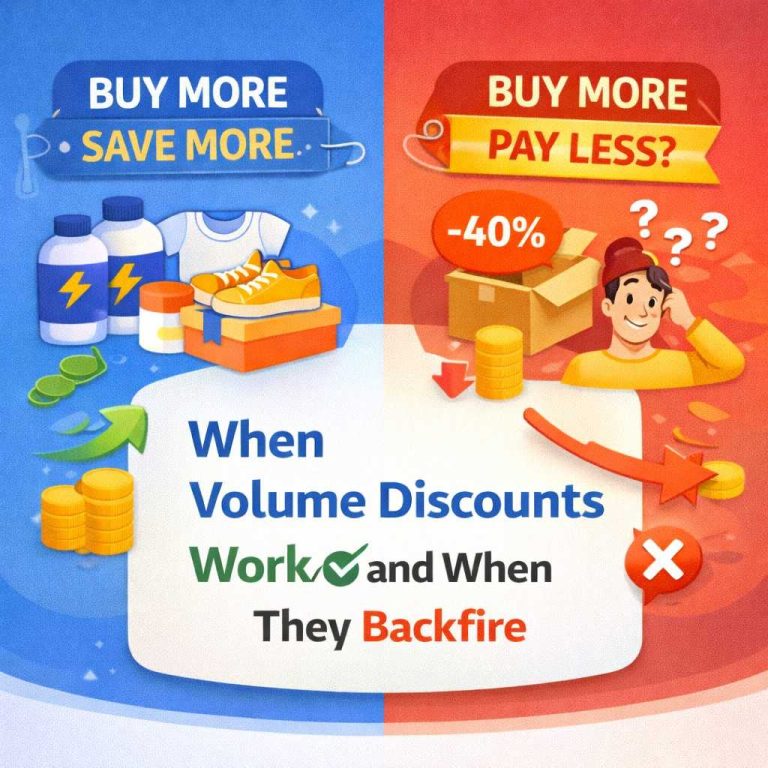
Volume discounts work when customers already intend to buy more than one unit and see clear value in doing so. They backfire when used to compensate for weak demand, unclear pricing, or low perceived value—often reducing margins without improving conversion or long-term revenue.
Why Volume Discounts Are So Easy to Misuse
Volume discounts feel like a safe lever. They’re familiar, easy to explain, and widely used across e-commerce. When revenue stalls, many Shopify merchants default to “Buy more, save more” without questioning whether the customer actually wants more.
This is where volume discounts quietly turn from a growth tactic into a margin leak.
Tools like Adoric Bundles Quantity Breaks exist precisely because volume pricing needs structure and context, not blanket discounts applied out of desperation.
What Volume Discounts Actually Change in Buyer Behavior
Volume discounts don’t create demand. They reshape quantity decisions.
When they work, they:
- Encourage customers who already want the product to buy more now
- Increase average order value without adding friction
- Feel like pricing logic, not persuasion
When they don’t work, they:
- Attract price-sensitive buyers only
- Reduce perceived value
- Train customers to wait for discounts
The difference lies in why the customer is buying.
When Volume Discounts Work Well
Volume discounts tend to perform best when three conditions are met.
1. The Product Is Naturally Multi-Unit
Products that customers already buy in multiples respond best:
- Apparel basics (tees, socks)
- Supplements and consumables
- Beauty refills
- B2B-lite supplies
In these cases, volume discounts remove hesitation rather than create it.
For a broader foundation on multi-item strategies, see
How to Create Product Bundles on Shopify
2. Margins Support Volume Incentives
Volume discounts only work if:
- Margins are healthy enough to absorb them
- Incremental profit still grows with quantity
If your margins rely on full-price single-unit sales, volume discounts often backfire silently.
3. The Offer Is Framed as Value, Not Urgency
Effective volume discounts feel like a smart choice, not a push.
This is why structured quantity breaks—clearly presented on the product page—outperform generic discount codes. They anchor pricing expectations instead of interrupting the buying flow.
When Volume Discounts Backfire
Most failures happen in predictable scenarios.
1. When They Mask Weak Product-Market Fit
If customers don’t want more units at full price, discounts rarely change that.
Instead, they:
- Lower revenue per unit
- Attract low-intent buyers
- Increase refund and churn risk
Discounts don’t fix demand problems—they expose them.
2. When They Replace Clear Pricing Strategy
Stores that rely heavily on volume discounts often lack:
- Clear value communication
- Strong product positioning
- Confident base pricing
This leads to constant discount escalation and shrinking margins.
For a deeper look at pricing psychology, see
How to Increase Average Order Value Without Discounts
3. When They Cannibalize Full-Price Sales
A common mistake is applying volume discounts universally.
This trains customers who would have bought one unit at full price to buy two at a discount, reducing revenue per visitor instead of increasing it.
Volume Discounts vs Structured Quantity Breaks
Not all volume discounts are equal.
Blunt volume discounts:
- Apply everywhere
- Reduce margins broadly
- Are hard to test incrementally
Structured quantity breaks:
- Are contextual
- Guide customers toward optimal quantities
- Preserve perceived value
This distinction matters. It’s the difference between reactive discounting and intentional pricing design.
For comparison against other monetization tactics, see
Bundles vs Upsells: What Increases Revenue per Visitor?
Real-World Shopify Examples
Apparel Store
Volume discounts work well for basics but backfire for statement pieces. Customers happily buy three tees, but discounting premium jackets often lowers perceived quality.
Supplements Brand
Quantity breaks increase AOV when framed as “30-day vs 90-day supply,” but aggressive discounts lead to stockpiling and delayed reorders.
B2B-Lite Store
Tiered pricing performs well when aligned with procurement logic, but blanket discounts confuse buyers who expect consistent unit pricing.
Common Mistakes Merchants Make
- Applying volume discounts to every product
- Using discounts to compensate for unclear value
- Ignoring margin math at higher quantities
- Training customers to expect perpetual discounts
- Confusing urgency with value
Most volume discount failures are strategy problems, not tooling problems.
Safer Alternatives to Test Before Discounting
Before committing to aggressive volume discounts, many merchants test:
- Quantity-based bundles
- Tiered pricing with clear anchors
- Product-page education instead of incentives
This is often where structured quantity logic—rather than raw discounts—creates sustainable AOV growth.
Frequently Asked Questions
Do volume discounts always increase AOV?
No. They only increase AOV when customers already want multiple units.
When do volume discounts hurt profit margins?
When margins are thin, demand is weak, or discounts replace full-price purchases.
Are volume discounts better than bundles?
Not always. Bundles often outperform discounts because they add perceived value instead of reducing price.
What products should not use volume discounts?
Low-frequency, premium, or one-time purchase products usually perform poorly with volume discounts.
How can Shopify stores test volume discounts safely?
By limiting scope, using clear quantity thresholds, and measuring revenue per visitor—not just conversion rate.
Final Thoughts
Volume discounts aren’t good or bad—they’re context-dependent.
Used intentionally, they increase AOV and simplify buying decisions. Used reactively, they quietly erode margins and train customers to expect less value.