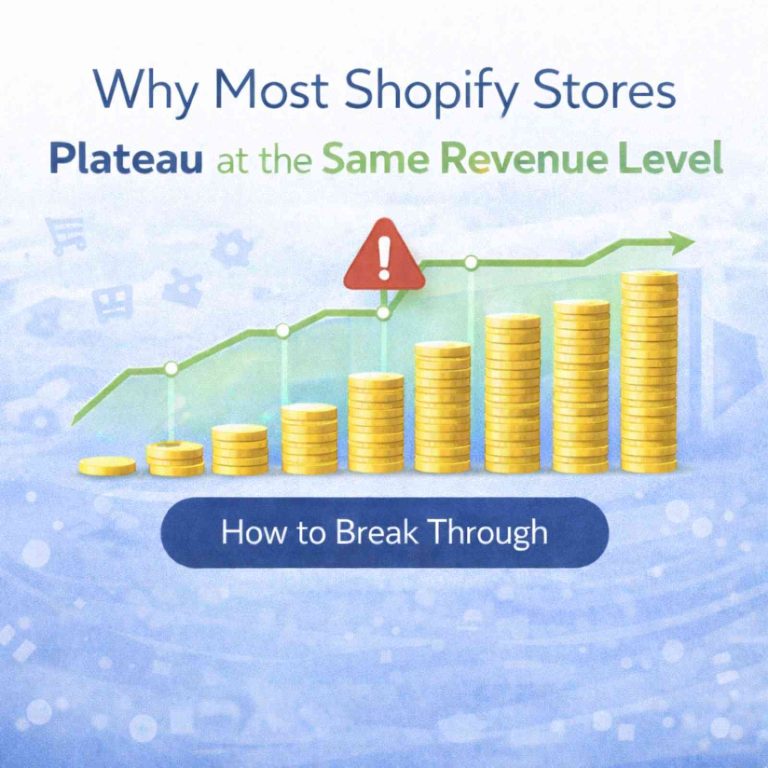
Most Shopify stores plateau because they rely on traffic and discounts while ignoring Average Order Value as a scalable growth lever. Once conversion rate and paid traffic efficiency stabilize, revenue growth slows unless buying behavior changes. Stores that break through do so by restructuring how customers buy—often using bundles and quantity-based pricing through tools like Adoric Bundles Quantity Breaks.
The Pattern Most Merchants Don’t Notice
Across Shopify, revenue plateaus tend to cluster. Many stores stall around similar monthly ranges—not because of competition, but because they’re operating under the same structural limits.
At first, growth comes easily. Traffic increases, conversion rate improves, and discounts drive urgency. Then something changes. Ads get more expensive. Conversion rate stabilizes. Promotions stop moving the needle. Revenue flattens even though effort increases.
This isn’t a motivation problem. It’s a system problem.
Why Traffic Stops Compounding
Traffic feels like the obvious lever, but it’s also the most fragile one. Paid acquisition eventually hits efficiency limits, while organic traffic grows slowly and unevenly.
More importantly, traffic alone doesn’t change how customers buy. If the average order stays the same, revenue growth becomes linear at best.
This is why stores with healthy traffic can still feel “stuck.”
The Hidden AOV Ceiling
Most Shopify stores unintentionally cap their AOV early. Product pages are designed for single-item purchases, checkout flows discourage add-ons, and pricing assumes one unit per order.
Once customers learn this pattern, behavior locks in.
Raising AOV later becomes difficult because customers are already trained to buy one item at a time. Discounts may spike short-term revenue, but they don’t change long-term purchasing habits.
Why Discounts Stop Working
Discounts work until customers expect them. Once expectation sets in, discounts stop feeling like value and start feeling like baseline pricing.
This creates three problems:
- Margins shrink
- Customers delay purchases
- AOV remains unchanged
Discounts change when people buy, not how they buy.
That’s why many stores find themselves running bigger promotions for smaller gains.
Buying Behavior Is the Real Bottleneck
Revenue plateaus happen when customer behavior stays static. If customers always buy one item, no amount of optimization will unlock exponential growth.
Changing behavior requires:
- A reason to buy more
- A clear structure that reduces decision friction
- Pricing logic that rewards higher intent
This is where bundles and quantity-based pricing matter—not as promotions, but as permanent buying paths.
How High-Growth Stores Break the Plateau
Stores that break through revenue ceilings don’t chase more traffic first. They redesign the purchase itself.
Examples across Shopify:
- Consumables use quantity breaks to normalize multi-unit orders
- Apparel brands bundle outfits instead of pushing single SKUs
- B2B-lite stores incentivize bulk buying without custom pricing
What’s consistent is that AOV becomes intentional, not accidental.
Many merchants implement this through a unified system like Adoric Bundles Quantity Breaks, because managing bundles and quantity logic separately often fragments UX and analytics.
For a practical AOV comparison, see
Quantity Breaks vs Bundles: Which Drives Higher AOV?
Why This Works Long-Term
When customers are guided to buy more per order:
- Revenue grows without proportional traffic growth
- Paid acquisition becomes more efficient
- Discounts become optional, not required
This creates compounding growth instead of constant re-optimization.
Common Mistakes That Lock Stores in a Plateau
These mistakes show up repeatedly:
- Treating AOV as a metric instead of a strategy
- Using discounts instead of restructuring offers
- Applying bundles randomly instead of by product behavior
- Waiting too long to introduce multi-item logic
Once customers are trained to buy single items, changing behavior takes more effort.
How to Diagnose Your Own Plateau
Ask yourself:
- Has AOV changed meaningfully in the last 6 months?
- Do customers have a clear reason to buy more than one item?
- Are discounts doing more work than structure?
If the answer is “no” to most of these, the plateau isn’t external—it’s internal.
Frequently Asked Questions
Why do Shopify stores stop growing after a certain point?
Because traffic and conversion rate stabilize while AOV remains flat.
Is traffic or conversion the main bottleneck?
Neither—buying behavior is.
Why do discounts lose effectiveness over time?
Customers anchor to them, turning promotions into expectations.
How does AOV create a revenue ceiling?
If customers only buy one item, revenue scales linearly regardless of traffic.
What’s the fastest way to break a Shopify growth plateau?
Change how customers buy, not how many customers you get.
Final Thought
Most Shopify growth plateaus aren’t caused by competition or market saturation. They’re caused by stores asking customers to buy the same way forever.