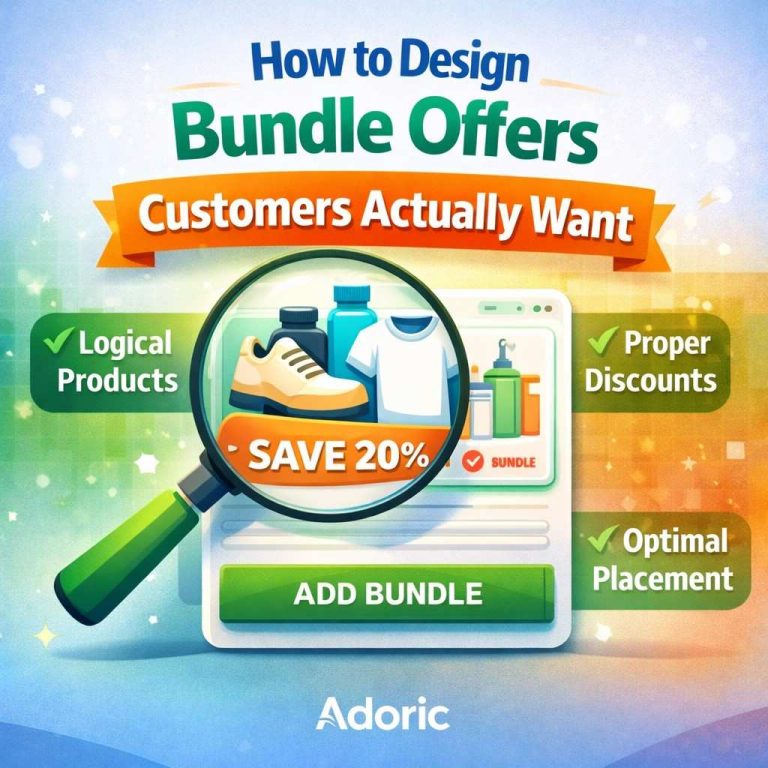
Bundle offers work when they reduce decision friction while increasing perceived value. The best bundles feel logical to customers—products that naturally go together, pricing that rewards larger purchases, and placement directly in the buying moment. For Shopify merchants, structured bundle systems like Adoric Bundles Quantity Breaks often turn bundles from promotional experiments into a reliable AOV growth mechanism.
Bundles themselves are not the strategy. Bundle design is.
Many stores add bundles and see little impact because the bundle structure doesn’t match how customers actually shop.
Why Most Bundle Offers Fail
Most bundle implementations fail for three predictable reasons:
- The products don’t logically belong together
- The discount is too small to change behavior
- The bundle appears too late in the buying journey
Customers rarely analyze bundles deeply. Instead, they make quick value judgments.
The mental question is simple:
“Does buying this bundle feel like the smart choice?”
If the answer isn’t obvious within a few seconds, the bundle gets ignored.
This is why bundles that are deeply integrated into the product page—rather than hidden in a separate section—tend to perform significantly better.
The Psychology Behind High-Converting Bundles
Customers evaluate bundles using three mental shortcuts:
1. Completeness
A bundle should solve a problem completely.
Examples:
- Skincare: Cleanser + toner + moisturizer
- Coffee: Beans + grinder + filters
- Fitness: Resistance bands + workout guide
The bundle feels like a system, not a random set of products.
When bundles feel complete, customers stop thinking about individual items and start thinking about outcomes.
2. Effort Reduction
Bundles reduce cognitive load.
Instead of browsing multiple products, customers choose a curated solution.
This is especially powerful in categories where customers feel uncertain:
- Supplements
- Skincare
- Hobby equipment
- Professional tools
A well-designed bundle removes the need for research.
3. Smart Savings
Discount depth matters less than discount clarity.
Customers prefer:
- “Buy 3, save 15%”
- “Complete set: save $20”
over vague offers like:
- “Bundle deal available”
Tiered quantity breaks are particularly effective here because they make the savings transparent and scalable.
Many Shopify stores implement these using Adoric Bundles Quantity Breaks, which embeds the tier structure directly into the product page so customers see the savings while deciding how many units to buy.
Choosing the Right Bundle Structure
Not all bundles work the same way. The structure should match the product category.
1. Quantity Break Bundles
Best for:
- Consumables
- Supplements
- Skincare
- Coffee
- Pet products
Example:
Buy 1 → Full price
Buy 2 → Save 10%
Buy 3 → Save 15%
Customers stock up, which increases both AOV and repeat purchase probability.
2. Complementary Product Bundles
Best for:
- Apparel
- Electronics
- Beauty routines
- Home goods
Example:
Camera + tripod + memory card.
These bundles increase cross-product exposure while improving perceived value.
3. Mix-and-Match Bundles
Best for:
- Apparel
- Snack brands
- Cosmetics
- Gift sets
Example:
Choose any 3 items, save 20%.
This approach maintains variety while encouraging multi-item purchases.
Bundle Placement Matters More Than Discount Size
Even excellent bundles fail if customers never see them.
The highest-performing placements are:
- Directly on the product page
- Near the Add to Cart button
- Within the purchase decision area
Bundles placed below reviews or deep in the page receive dramatically less engagement.
This is why embedded bundle modules often outperform separate bundle landing pages.
Pricing Bundles Without Destroying Margin
Bundle discounts should reward larger carts—not penalize single-item buyers.
A useful guideline:
| Bundle Size | Typical Discount |
|---|---|
| 2 items | 8–12% |
| 3 items | 12–18% |
| 4+ items | 15–22% |
The goal is behavior change, not maximum discount.
If the difference between tiers is too small, customers will default to buying one item.
If the discount is too aggressive, margin disappears.
The optimal bundle nudges the customer upward without feeling pushy.
Real Shopify Examples
Skincare Brand
Instead of discounting products individually, the brand launched:
“Complete Routine Bundle”
- Cleanser
- Serum
- Moisturizer
Result: higher AOV and better product adoption.
Coffee Brand
They introduced quantity breaks:
Buy 2 bags → Save 10%
Buy 3 bags → Save 15%
Customers began purchasing monthly supply instead of a single bag.
Streetwear Brand
Instead of sitewide discounts:
“Buy Any 2 Tees, Save 12%”
Customers began building outfits rather than purchasing single pieces.
Common Mistakes Merchants Make
- Bundling unrelated products together
- Making discounts too small to matter
- Overcomplicating bundle tiers
- Placing bundles too low on the page
- Treating bundles as temporary promotions instead of core merchandising
Bundles work best when they become part of the store’s default buying logic, not just a seasonal campaign.
The Long-Term Role of Bundles in AOV Growth
Bundles change the customer’s question.
Instead of asking:
“Should I buy this product?”
Customers start asking:
“How many should I buy?”
That shift—from purchase decision to purchase depth—is what makes bundles one of the most reliable AOV levers in ecommerce.
When implemented thoughtfully, bundles increase:
- Order size
- Product discovery
- Customer satisfaction
- Repeat purchase likelihood
They turn a single product purchase into a system purchase.
FAQ
What makes a bundle offer attractive to customers?
Bundles work when products logically belong together and the savings are clear and easy to understand.
How much discount should a bundle include?
Usually between 10–20%, depending on bundle size and margin structure.
What products should be bundled together?
Products that customers naturally use together or purchase repeatedly.
Do bundles increase Shopify AOV?
Yes. Bundles increase the number of items per order, which directly raises average order value.
Should bundles appear on product pages or cart pages?
Product pages usually perform better because the customer sees the offer while deciding what to buy.
Bundles are not just a pricing tactic.
They are a merchandising strategy.
The real question for Shopify merchants is not whether bundles work—it’s whether your bundles are designed around how customers actually buy.
So the next time you look at your product pages, ask yourself:
Does the bundle make the buying decision easier—or just more complicated?