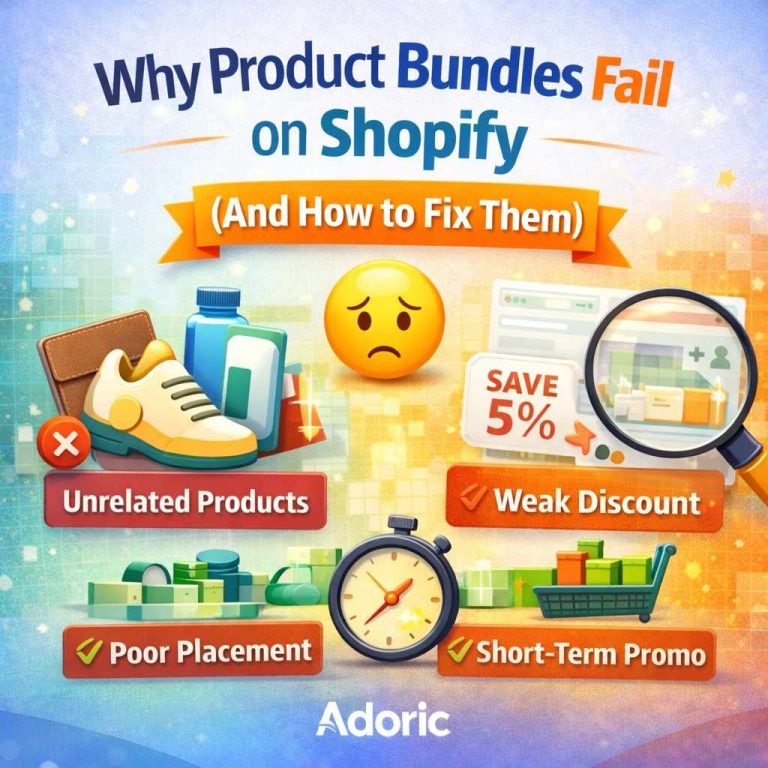
Product bundles usually fail on Shopify not because the idea is wrong, but because the design is wrong. When bundles combine unrelated products, offer weak incentives, or appear too late in the buying journey, customers simply ignore them. High-performing bundles—often implemented through systems like Adoric Bundles Quantity Breaks—work because they align with how customers naturally purchase multiple products.
Bundles are one of the most reliable ways to increase Average Order Value (AOV).
But most bundles don’t work.
The reason isn’t technology.
It’s strategy.
The Real Goal of Product Bundles
Before discussing why bundles fail, it’s important to understand their role.
Bundles are not primarily a discount tactic.
They are a purchase depth strategy.
The goal is to move customers from:
“Should I buy this product?”
to:
“How many products should I buy?”
This shift increases AOV without requiring more traffic.
Reason 1: The Products Don’t Belong Together
The most common bundle mistake is combining products that have no natural relationship.
Customers instantly notice this.
Examples of weak bundles:
- T-shirt + sunglasses + wallet
- Coffee beans + mug + random snack
- Shampoo + unrelated skincare item
These combinations feel artificial.
Customers assume the bundle exists only to clear inventory.
Successful bundles, on the other hand, feel logical.
Examples:
Skincare routine
- Cleanser
- Toner
- Moisturizer
Fitness kit
- Resistance bands
- Workout guide
- Foam roller
Camera setup
- Camera
- Tripod
- Memory card
When products solve a single problem together, bundles feel valuable.
Reason 2: The Discount Is Too Weak
Customers need a clear reason to purchase multiple items.
If the bundle discount is small, the incentive disappears.
Example:
Bundle discount: 5%
Customers will often ignore it.
A more effective structure:
- Buy 2 → Save 10%
- Buy 3 → Save 15%
This tiered approach encourages customers to increase cart size.
Many Shopify merchants implement this using Adoric Bundles Quantity Breaks, which places the pricing tiers directly on the product page where customers make purchase decisions.
Reason 3: Bundles Appear Too Late in the Journey
Even good bundles fail if customers never see them.
Common placement mistakes include:
- Bundles only in the cart page
- Bundles hidden below reviews
- Bundles placed on separate landing pages
Bundles perform best when they appear during the purchase decision.
The ideal placement is:
- On the product page
- Near the Add to Cart button
- Within the decision zone
When customers see bundle options while choosing quantity, they are far more likely to increase their order.
Reason 4: The Bundle Is Too Complicated
Bundles should simplify purchasing, not complicate it.
Overly complex bundles introduce friction.
Examples of complicated offers:
- Too many bundle combinations
- Confusing pricing structures
- Multi-step bundle builders
Customers prefer simple options.
Example:
Buy 2 → Save 10%
Buy 3 → Save 15%
This structure is clear, quick, and easy to understand.
In contrast, complex bundle logic often slows decision-making.
Reason 5: Treating Bundles as Promotions Instead of Merchandising
Many Shopify stores treat bundles like seasonal campaigns.
Example:
- Launch bundle
- Run promotion
- Remove bundle later
But the most successful stores treat bundles as permanent merchandising infrastructure.
Bundles work best when they are integrated into the product page experience.
This is why bundle systems—rather than manual discounts—often produce stronger results.
Our article Bundles vs Flash Sales: Which Is Better Long-Term? explains why bundle strategies outperform temporary promotions in many cases.
Real Shopify Examples
Coffee Brand
Average product price: $14
Problem: Customers bought one bag.
Solution:
Buy 2 → Save 10%
Buy 3 → Save 15%
Customers began purchasing multiple bags per order.
Apparel Brand
Product price: $25
Bundle:
Buy 2 shirts → Save 12%
Customers began building outfits rather than purchasing single items.
Skincare Brand
Instead of selling individual products, the store launched:
Complete routine bundle
Customers purchased the entire skincare system.
Common Mistakes Merchants Make
- Bundling unrelated products
- Offering discounts that are too small
- Making bundles too complicated
- Hiding bundles below the product page
- Treating bundles as short-term campaigns
Bundles succeed when they align with how customers naturally buy products together.
When Bundles Don’t Work Well
Bundles are less effective when:
- Products are expensive
- Customers rarely purchase multiples
- Inventory levels fluctuate heavily
In those situations, other AOV strategies may work better.
However, for consumables, apparel basics, accessories, and beauty products, bundles remain one of the most consistent growth drivers.
Why Bundles Still Matter for Shopify Growth
Traffic is expensive.
Customer acquisition costs continue to rise.
Increasing order value per customer is often the most sustainable growth lever.
Bundles help achieve that by encouraging multi-item purchases without requiring additional traffic.
FAQ
Why do product bundles fail on Shopify?
Most bundles fail because the products don’t logically belong together, the discount is too small, or the bundle appears too late in the buying journey.
What products should be bundled together?
Products that naturally solve a problem together or are commonly used together.
How much discount should a bundle include?
Typically between 10–20%, depending on the number of items.
Where should bundles appear on Shopify product pages?
Bundles perform best when placed near the Add to Cart button where customers make purchase decisions.
Do bundles increase average order value?
Yes. Bundles encourage customers to purchase multiple products instead of a single item.
Bundles fail when they feel artificial.
They succeed when they make the buying decision easier.
So the next time you review your bundle strategy, ask yourself:
Does this bundle solve a real customer problem—or just combine products for the sake of discounting?