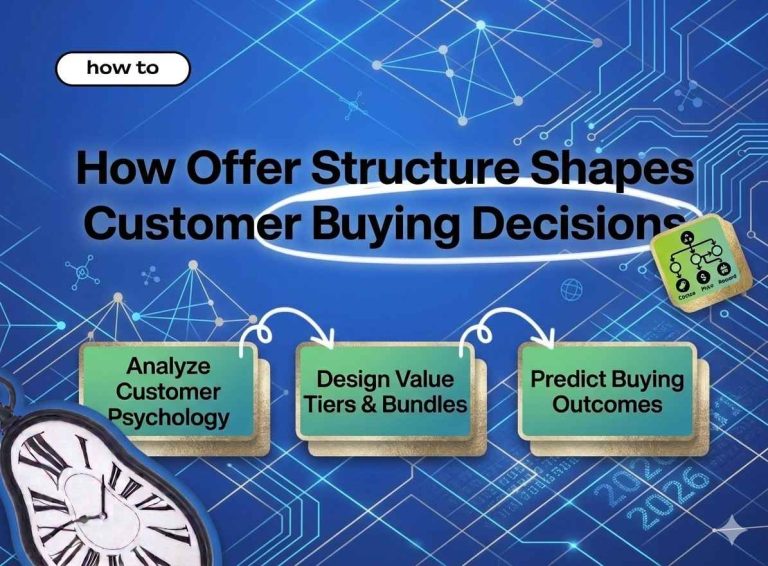
Offer structure determines how customers interpret value and make decisions. Instead of evaluating a single price, shoppers compare options, look for the best value, and choose the path that feels most logical. Shopify stores that structure offers clearly—through bundles, quantity breaks, and pricing tiers—consistently increase both conversion and average order value.
Customers don’t just react to what you sell. They react to how you present the choice.
Why Offer Structure Matters More Than Most Merchants Realize
Most ecommerce stores focus heavily on product quality, branding, and marketing. These matter—but they don’t fully explain why customers choose one option over another.
In many cases, the deciding factor is how the offer is structured.
A single-product offer forces a yes/no decision. A structured offer creates a comparison.
And comparison changes behavior.
This is why two stores selling the same product at the same price can produce very different results. One guides the decision. The other leaves it open.
The Core Principle: Customers Choose Between Options, Not Products
Customers rarely evaluate a product in isolation.
Even when there is only one product, they compare:
- quantity options
- price variations
- perceived value levels
This means that introducing structured options changes the decision itself.
Instead of asking:
“Should I buy this?”
customers ask:
“Which option should I choose?”
That shift is one of the most powerful drivers of higher AOV.
How Structured Offers Reduce Decision Friction
Decision friction is one of the biggest causes of lost revenue.
Customers hesitate when:
- value is unclear
- options feel confusing
- the “best choice” is not obvious
Structured offers reduce friction by:
- limiting choices to meaningful options
- highlighting the best-value option
- guiding customers toward a clear decision
This is why “good, better, best” pricing models consistently outperform unstructured pricing.
The Role of Bundles in Offer Structure
Bundles are one of the most effective ways to shape buying decisions because they redefine what is being evaluated.
Instead of evaluating a product, customers evaluate a package.
This changes:
- how value is perceived
- how price is interpreted
- how confident the decision feels
Bundles work especially well when they:
- reflect natural usage
- combine complementary items
- simplify the purchase
For a deeper breakdown of bundle design, see
How to Design Bundle Offers Customers Actually Want
Why Quantity Breaks Influence Behavior
Quantity breaks are powerful because they build on an existing decision.
A customer who already wants one unit is not deciding whether to buy—they are deciding how much to buy.
This reduces resistance and increases order size.
This is why structured quantity pricing—like what’s enabled by Adoric Bundles Quantity Breaks—often increases AOV without hurting conversion rates. It presents value directly where the decision is made.
For a deeper comparison with other approaches, see
Bundles vs Upsells: What Increases Revenue per Visitor?
Anchoring and Value Perception
Offer structure also influences how customers interpret price.
When multiple options are presented:
- higher-priced options act as anchors
- mid-tier options feel reasonable
- best-value options stand out
For example:
- Buy 1 → standard price
- Buy 2 → better value
- Buy 3 → best value
Most customers don’t calculate savings precisely. They rely on structure to guide their decision.
For a deeper explanation of pricing behavior, see
The Psychology of Pricing in Ecommerce
Real Shopify Examples
Apparel Store
Introducing structured quantity options for basics increased AOV because customers naturally prefer buying multiple items when value is clear.
Skincare Brand
Offering 30-day vs 90-day bundles simplified decisions and increased order size by aligning with usage patterns.
B2B-Lite Ecommerce
Tiered pricing matched buyer expectations, reducing friction and increasing order value.
When Offer Structure Doesn’t Work
Offer structure alone cannot fix deeper issues such as:
- weak product-market fit
- unclear value proposition
- poor product page design
If customers don’t understand the product, structured offers will have limited impact.
Offer structure works best when it enhances an already strong product.
Common Mistakes Merchants Make
- offering only one purchase option
- creating too many confusing choices
- hiding value differences
- relying heavily on discounts
- not highlighting the best-value option
These mistakes increase friction and reduce order size.
How to Improve Offer Structure
Improving offer structure typically involves:
- introducing 2–3 clear purchase options
- using bundles or quantity tiers
- labeling the best-value option
- simplifying the decision path
- aligning offers with real customer behavior
The goal is not to give customers more choices—it’s to make the right choice obvious.
Frequently Asked Questions
What is offer structure in ecommerce?
Offer structure refers to how purchase options are presented, including pricing tiers, bundles, and quantity options.
Why does offer structure affect buying decisions?
Because customers evaluate value through comparison, not isolation.
How do bundles influence customer behavior?
They shift focus from price to total value, reducing price sensitivity.
What is the best way to structure product offers?
Use clear tiers, highlight the best value, and limit choices to meaningful options.
How can Shopify stores improve offer structure?
By simplifying choices, using bundles and quantity breaks, and guiding customers toward higher-value decisions.
Final Thoughts
Customers don’t just decide whether to buy—they decide how to buy.
Offer structure determines how that decision feels: simple or confusing, valuable or uncertain.
Stores that design their offers intentionally don’t rely on persuasion. They create a path where the best choice is clear.
Instead of asking “Why aren’t customers converting?”, a more useful question is:
“Are we structuring the decision in a way that makes sense to them?”
That’s where better conversion—and higher AOV—begins