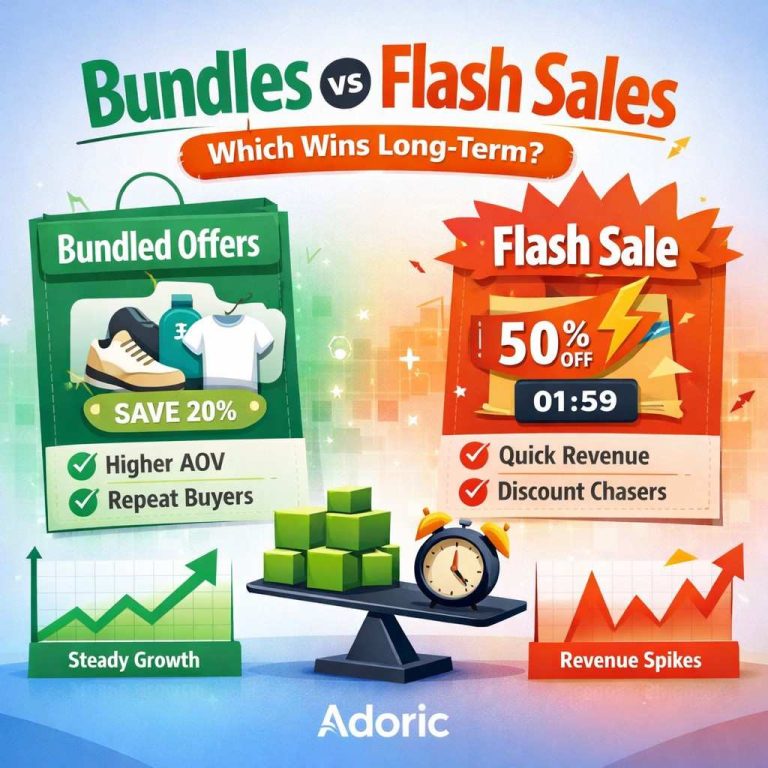
For most Shopify stores, bundles create more durable growth than flash sales. Flash sales spike short-term revenue but condition customers to wait for discounts, while well-designed bundles increase AOV, protect margins, and improve repeat purchase behavior. Long-term, bundles compound; flash sales reset expectations.
For merchants serious about sustainable AOV growth, tools like Adoric Bundles Quantity Breaks have become the structural layer behind bundle-led strategies—especially when the goal is margin-safe expansion rather than short-lived revenue spikes.
The Core Difference: Revenue Spike vs Revenue Structure
Flash sales are event-based. Bundles are infrastructure-based.
A flash sale temporarily lowers price to increase urgency. A bundle increases perceived value while maintaining—or strategically reshaping—price structure. One is an interruption tactic. The other is a merchandising strategy.
That difference matters because Shopify growth is rarely limited by traffic alone. It’s limited by:
- AOV ceiling
- Margin pressure
- Repeat purchase rate
- Brand positioning
Flash sales influence the first. Bundles influence all four.
1. Profitability: Discounting vs Value Engineering
Flash sales increase conversion by lowering friction: “Buy now, it’s cheaper.” The mechanism is simple—reduced price reduces resistance. But the cost is margin compression.
If you run 25% off sitewide:
- Your CAC doesn’t drop.
- Your payment processing fees don’t drop.
- Your ad costs don’t drop.
- Your margins do.
Bundles, especially structured bundles and quantity breaks, work differently. Instead of cutting price per unit, they:
- Increase order size
- Improve unit economics (shipping per item decreases)
- Move slower inventory
- Encourage complementary purchases
For example:
- Apparel: “Buy 2 tees, get 15% off” increases units per order without sitewide discounting.
- Consumables: “Buy 3, save 12%” increases stock-up behavior and reduces churn risk.
- B2B-lite stores: Tiered quantity breaks raise average order volume without looking promotional.
This is why serious AOV-focused merchants lean into structured bundle systems rather than temporary price cuts. If you’re exploring structured implementation.
2. Customer Conditioning: What Behavior Are You Training?
Flash sales train customers to wait.
If your store runs 30% off every 6–8 weeks, customers quickly internalize the cycle. Conversion shifts from “Do I want this?” to “When is the next discount?”
Bundles train customers to buy more, not wait longer.
That behavioral difference compounds over time. When bundles become a permanent part of your product page experience—especially with systems like Adoric Bundles Quantity Breaks integrated directly into the product flow—the offer feels structural, not temporary. Customers learn that buying more is smart, not that waiting is smarter.
The result:
- Higher immediate AOV
- Less price sensitivity
- More predictable revenue
3. AOV vs LTV: Short-Term Lift vs Repeat Purchase Impact
Flash sales optimize conversion rate in the moment. Bundles influence purchase depth and repeat probability.
Let’s break it down:
Flash Sale Impact
- Conversion rate: ↑ (temporarily)
- AOV: Mixed (can drop if discount applied to small carts)
- LTV: Often neutral or lower (deal-seeking cohort)
Bundle Impact
- Conversion rate: Stable or slightly ↑
- AOV: ↑↑ (structurally)
- LTV: ↑ (more product exposure, higher commitment)
In consumables (e.g., supplements, skincare, pet products), quantity breaks increase product familiarity and usage continuity. Customers who buy three units are less likely to churn after one cycle.
In apparel, curated bundles introduce customers to new SKUs—raising future purchase probability.
This is why bundle-led stores often see improvements not just in AOV but in repeat rate and contribution margin over time.
4. Operational Sustainability
Flash sales are operationally heavy:
- Campaign planning
- Ad creative updates
- Email and SMS coordination
- Inventory risk (spikes and stockouts)
- Support load increases
Bundles are operationally lighter once structured correctly. With an integrated system like Adoric Bundles Quantity Breaks, bundles:
- Sync across Online Store and POS
- Work with cart drawers
- Integrate with subscriptions
- Remain evergreen
Instead of building campaigns repeatedly, you build conversion infrastructure once and optimize.
For stores scaling toward operational efficiency in 2026+, infrastructure usually wins over repeated promotions.
5. When Flash Sales Still Make Sense
Flash sales are not inherently bad. They’re just misused when over-relied on.
Strategic use cases:
- Clearing seasonal inventory
- Launch events with limited supply
- Black Friday / Cyber Monday
- Reactivating dormant segments
The key is containment. Flash sales should be episodic, not foundational.
If flash sales are your primary growth engine, you are building volatility into your revenue model.
Edge Cases & Industry Examples
Apparel Brand (Mid-Ticket, $60–$120 AOV)
Bundles: “Complete the look” sets or tiered volume discounts protect margins. Flash sales here risk devaluing perceived quality.
Consumables (Skincare, Supplements)
Quantity breaks outperform flash sales long-term because they encourage stock-up behavior and reduce reorder friction.
B2B-lite (Office Supplies, Beauty Professionals)
Tiered quantity pricing signals wholesale logic without requiring wholesale infrastructure.
In each case, bundles reinforce purchasing logic. Flash sales disrupt it.
Common Mistakes Merchants Make
- Running flash sales to solve AOV problems.
- Using bundles that are visually buried or disconnected from the buy button.
- Offering bundles that feel random rather than behavior-driven.
- Over-discounting bundles to compete with flash sale psychology.
- Treating AOV tactics as campaigns instead of structural levers.
If bundles are implemented as an afterthought instead of embedded into the product page experience, they underperform. For implementation nuance, see our related breakdown on [Quantity Breaks vs Product Bundles: What’s the Difference?] (sideways link).
So Which Is Better Long-Term?
For most Shopify merchants focused on sustainable growth, bundles outperform flash sales long-term because they:
- Protect margin structure
- Increase AOV structurally
- Improve repeat purchase behavior
- Reduce customer price sensitivity
- Create operational stability
Flash sales increase volatility. Bundles increase leverage.
This doesn’t mean abandoning flash sales entirely. It means understanding which lever builds equity—and which one spends it.
If you’re evaluating AOV strategy more broadly, our article on [How to Increase Average Order Value on Shopify] provides a strategic overview of compounding tactics beyond discounting.
FAQ
Are bundles more profitable than flash sales on Shopify?
In most cases, yes. Bundles increase order size without compressing margin across the entire catalog.
Do flash sales hurt long-term brand value?
Repeated flash sales can condition customers to delay purchases and anchor value to discounts.
How do bundles affect repeat purchase rate?
Bundles often increase repeat rate by exposing customers to more products and encouraging stock-up behavior.
When should a Shopify store run a flash sale?
For inventory liquidation, seasonal events, or high-impact launches—not as a primary growth model.
Can you combine bundles and flash sales?
Yes, but bundles should remain structural while flash sales remain episodic.