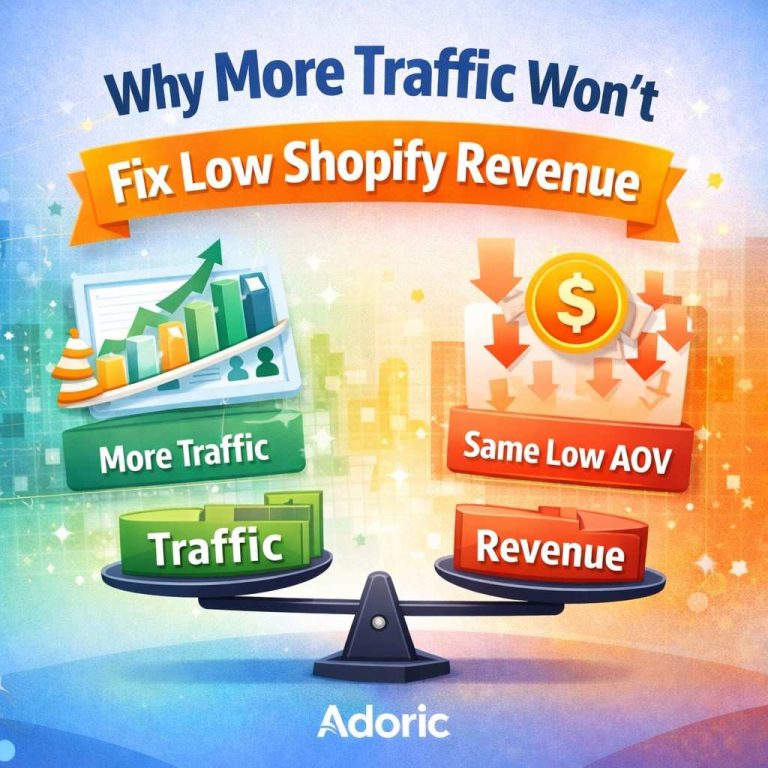
More traffic rarely fixes low Shopify revenue because traffic only affects one part of the revenue equation. If conversion rate and average order value (AOV) are weak, increasing visitors simply multiplies inefficiency. In many cases, improving purchase depth—through strategies like bundles or quantity breaks implemented with tools such as Adoric Bundles Quantity Breaks—has a larger impact on revenue than acquiring more visitors.
Many Shopify merchants assume revenue problems are traffic problems.
But in practice, the issue is often order economics.
The Shopify Revenue Equation Most Merchants Ignore
Revenue in ecommerce comes from three variables:
Revenue = Traffic × Conversion Rate × Average Order Value
Most marketing advice focuses on the first variable. Ads, SEO, influencer campaigns, and social media all aim to increase traffic.
But if the other two variables remain unchanged, traffic simply scales the same results.
Example:
| Metric | Before | After Traffic Increase |
|---|---|---|
| Traffic | 10,000 | 20,000 |
| Conversion Rate | 1.5% | 1.5% |
| AOV | $55 | $55 |
| Revenue | $8,250 | $16,500 |
Now imagine a different scenario.
Instead of doubling traffic, the store increases AOV from $55 to $75.
Revenue becomes $11,250 with the same traffic.
That improvement is often easier—and cheaper—than acquiring twice the visitors.
Why Traffic-First Growth Strategies Often Fail
Traffic feels like the obvious lever because it is visible.
You can measure clicks, impressions, and ad spend daily. But traffic also has two major limitations.
1. Traffic Gets More Expensive Over Time
Customer acquisition costs rarely decrease as a store scales.
As more brands compete for the same audience:
- CPM increases
- CPC increases
- CAC increases
If order value and margins remain static, growth eventually becomes unprofitable.
2. Traffic Doesn’t Change Purchase Behavior
Traffic increases exposure, not purchase depth.
If your store has:
- Single-product purchases
- Small carts
- No upsell structure
Then more visitors simply produce more small orders.
This is why many scaling brands focus on AOV before traffic expansion.
The Overlooked Lever: Average Order Value
Average Order Value determines how much revenue each customer generates.
Improving AOV means every new customer becomes more valuable immediately.
Common AOV strategies include:
- Bundles
- Quantity breaks
- Cross-sells
- Product sets
- Mix-and-match offers
Among these, bundles and quantity breaks tend to produce the most consistent results because they influence the purchase decision itself.
Tools like Adoric Bundles Quantity Breaks are often used to embed these offers directly into the product page, allowing customers to increase their cart size while making the buying decision.
How Bundles Change Order Economics
Bundles change the question customers ask.
Instead of asking:
“Should I buy this product?”
Customers start asking:
“How many should I buy?”
That shift—from purchase decision to purchase depth—is powerful.
Example:
Consumables brand
Before bundles:
- Customers buy 1 unit.
After quantity breaks:
- Buy 2 → save 10%
- Buy 3 → save 15%
Customers begin stocking up instead of buying once.
The result:
- Higher AOV
- Higher product usage
- Higher repeat purchase likelihood
Real Shopify Examples
Apparel Store
Traffic doubled after influencer campaigns.
Revenue increased, but profit barely moved because most customers bought a single item.
Introducing:
“Buy 2 Tees, Save 12%”
changed purchase behavior.
Average items per order increased.
Coffee Brand
Ads were already driving strong traffic.
But customers typically purchased one bag.
After introducing quantity breaks:
Buy 2 → Save 10%
Buy 3 → Save 15%
Average order value increased significantly without additional traffic spend.
Professional Beauty Supply (B2B-lite)
Salon owners rarely buy one product.
Tiered pricing aligned with professional purchasing patterns.
Larger orders became the default.
When Traffic Is the Real Problem
Traffic becomes the bottleneck when:
- Conversion rate is already strong
- AOV is optimized
- Product demand is validated
- Repeat purchase behavior exists
In these cases, scaling traffic makes sense because the store already converts efficiently.
But many stores attempt traffic scaling before fixing the purchase experience.
That sequence is backwards.
Common Mistakes Merchants Make
- Increasing ad spend before improving AOV.
- Running constant discounts instead of structured bundles.
- Ignoring cart size and focusing only on conversion rate.
- Treating bundles as promotions instead of core merchandising.
- Scaling traffic without understanding contribution margin.
Revenue problems are rarely caused by a single metric.
They usually come from imbalanced economics.
Traffic vs Revenue: The Real Priority
Traffic is the top of the funnel.
Revenue is the outcome of the entire buying system.
If that system encourages small purchases, scaling traffic only amplifies the limitation.
This is why many Shopify stores now treat bundles, quantity breaks, and cross-sells as infrastructure, not campaigns.
FAQ
Why doesn’t more traffic always increase Shopify revenue?
Because traffic only increases visitors. If conversion rate or AOV remain low, revenue growth will be limited.
What matters more: traffic, conversion rate, or AOV?
All three matter, but AOV improvements often produce the fastest revenue gains without increasing acquisition costs.
How do bundles increase Shopify revenue?
Bundles increase the number of items purchased per order, which directly raises average order value.
Should I focus on AOV before scaling ads?
Often yes. Increasing AOV improves the profitability of every future customer acquisition.
When is traffic actually the main problem?
When conversion rate and AOV are already optimized and demand exists.
Revenue growth rarely comes from one lever.
Traffic gets attention because it’s visible.
But the stores that scale sustainably tend to focus on what happens after the visitor arrives.
So the next time revenue stalls, the better question might be:
Is the problem really traffic—or is it what happens once the customer lands on your product page?