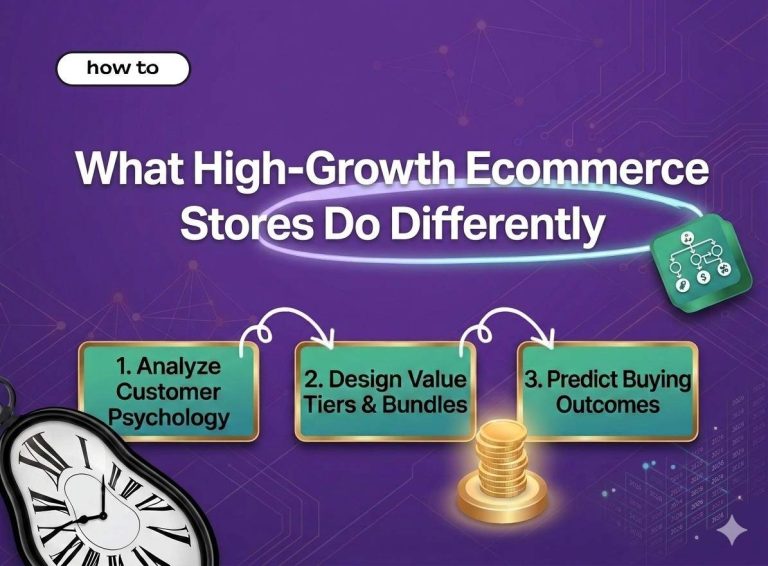
High-growth ecommerce stores don’t just focus on getting more traffic—they focus on making each visitor more valuable. They increase revenue through better pricing, structured offers, and higher average order value, often using bundles and quantity-based pricing to scale efficiently without relying solely on marketing spend.
The difference is not just in what they sell, but in how they structure the buying decision.
Growth Is Not Just About Traffic
Many Shopify merchants assume that growth comes from acquiring more visitors.
More ads, more content, more channels.
But high-growth stores understand something different: traffic is only one side of the equation.
If each visitor generates limited revenue, scaling traffic becomes expensive and unsustainable. This is why top-performing stores focus early on revenue per visitor, not just acquisition.
They Optimize AOV Before Scaling Traffic
One of the biggest differences between average and high-growth stores is when they focus on AOV.
Average stores:
- increase ad spend first
- optimize pricing later
High-growth stores:
- optimize order value first
- scale traffic second
This approach works because every improvement in AOV makes marketing more efficient.
Bundles and structured pricing—like those enabled by Adoric Bundles Quantity Breaks—play a key role here. They allow stores to increase order size without increasing friction.
They Turn Best-Sellers Into Revenue Engines
High-growth stores don’t constantly chase new products. They maximize the products that already work.
Instead of:
- adding more SKUs
they:
- create multiple purchase options
- introduce quantity tiers
- bundle around the core product
This turns a best-seller into a system that generates more revenue per customer.
They Structure Offers Instead of Just Setting Prices
Pricing is not just about numbers—it’s about structure.
High-growth stores rarely show a single price. They present options:
- Buy 1
- Buy 2 (better value)
- Buy 3 (best value)
This creates comparison and guides customers toward higher-value decisions.
This is fundamentally different from relying on discount codes or static pricing.
They Reduce Decision Friction
High-growth stores understand that customers don’t want to think too much.
They design product pages to:
- simplify decisions
- highlight the best option
- remove unnecessary choices
This often includes:
- “Most Popular” labels
- clear value comparisons
- limited but meaningful options
Reducing friction increases both conversion and order value.
They Align With Natural Buying Behavior
Top-performing stores don’t force behavior—they align with it.
Examples:
- consumables → multi-month bundles
- apparel basics → multi-unit purchases
- B2B-lite → tiered pricing
Instead of pushing customers to buy something new, they encourage them to buy more of what they already want.
This is why bundles and quantity breaks are so effective—they match how customers naturally think.
They Focus on Systems, Not Tactics
Average stores rely on tactics:
- run a promotion
- test a new ad
- launch a new product
High-growth stores build systems:
- pricing structure
- bundle logic
- product page optimization
These systems consistently increase revenue across all traffic sources.
Real Shopify Examples
Apparel Brand
A store increased revenue by introducing “buy 2” and “buy 3” offers for basics, improving AOV without increasing traffic.
Supplements Brand
Instead of scaling ads, the brand introduced 90-day bundles, increasing revenue per visitor and profitability.
B2B-Lite Ecommerce
Tiered pricing aligned with customer expectations, increasing order size and reducing reliance on discounts.
When This Approach Doesn’t Work
Not every store can immediately apply these strategies.
They are less effective when:
- traffic is extremely low
- product value is unclear
- there is no repeat or multi-unit demand
In these cases, product positioning and awareness should be addressed first.
Common Mistakes Merchants Make
- focusing only on traffic growth
- relying heavily on discounts
- ignoring AOV optimization
- offering only one purchase option
- launching new products too early
These mistakes lead to growth that is expensive rather than efficient.
How to Move Toward High-Growth Behavior
To start thinking like a high-growth store:
- optimize pricing structure
- introduce bundles or quantity tiers
- improve product page clarity
- focus on revenue per visitor
- treat your best products as systems, not items
These changes often unlock growth without increasing complexity.
Frequently Asked Questions
What makes an ecommerce store high-growth?
A focus on efficient revenue generation, strong AOV, and scalable systems rather than just traffic.
Why do successful Shopify stores focus on AOV?
Because increasing order value improves profitability across all channels.
How do bundles contribute to growth?
They increase perceived value and encourage larger purchases.
What do top-performing stores do differently from average stores?
They structure offers, reduce friction, and focus on revenue per visitor.
How can a Shopify store become a high-growth business?
By optimizing pricing, offer structure, and product page design before scaling traffic.
Final Thoughts
High-growth stores don’t rely on more effort—they rely on better structure.
They don’t just bring customers in. They make each customer more valuable.
Instead of asking “How do we grow faster?”, a more effective question is:
“Are we maximizing the value of every customer we already have?”
That shift is what turns steady growth into scalable growth.