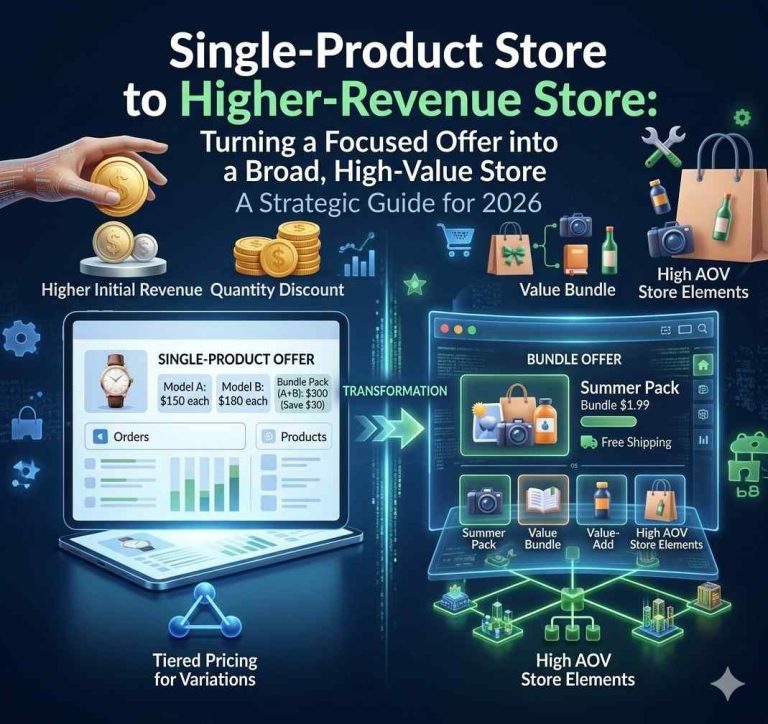
Single-product stores increase revenue by expanding how customers buy, not necessarily what they buy. The most effective strategies are quantity-based pricing, bundles, offer structure, and purchase design that increase average order value without forcing the brand to launch new products.
Many single-product Shopify stores assume they need more SKUs to grow. In reality, many can grow faster by making their core product easier to buy in larger, smarter, and more valuable ways.
Why Single-Product Stores Hit Revenue Ceilings
Single-product stores are strong at focus. They usually have clearer messaging, stronger product pages, and less decision fatigue than general stores. That focus is often what makes them convert well in the first place.
The problem appears later. Once the best-performing traffic and audience segments are already converting, growth slows because there is only one obvious purchase path: buy one unit, once. Without a better purchase structure, revenue becomes dependent on more traffic rather than better monetization.
This is why many merchants mistake a purchase model problem for a catalog problem.
The Real Constraint Is Usually Order Structure, Not Product Count
If a store sells one hero product, the revenue ceiling is often shaped by three variables:
- How many units customers buy
- How often they buy
- How much value the offer communicates before checkout
That means the question is not always “What new product should we add?” It is often “How can we make the current product generate larger, more profitable orders?”
This is exactly where structured offer logic becomes important. Solutions like Adoric Bundles Quantity Breaks are relevant because they help single-product stores create multiple purchase paths from one core product—especially through quantity breaks and bundle-style pricing that increase AOV without diluting the brand.
Strategy #1: Turn One Product Into Multiple Purchase Options
A single-product store doesn’t need more products to create more options. It needs more purchase formats.
The easiest place to start is with variations like:
- Buy 1
- Buy 2 and save
- Buy 3 for best value
This works because customers are no longer choosing only whether to buy. They are choosing how much value they want to get from the purchase. That subtle shift is powerful.
For consumables, supplements, beauty products, and everyday-use products, quantity-based offer design often outperforms catalog expansion because it aligns with natural customer behavior.
Strategy #2: Use Quantity Breaks to Create a Better Buying Decision
Quantity breaks are especially effective for single-product stores because they don’t require a second product to exist.
Instead of saying:
- “Here’s another item you may want”
they say:
- “Here’s a smarter way to buy the product you already want”
This matters because upsells often introduce a second decision, while quantity breaks enhance the first decision. That usually results in less friction and better revenue per visitor.
This is one reason quantity-based pricing works so well for single-product stores: it increases order value without changing the brand promise.
Strategy #3: Reframe the Product Around Use Cases or Time Horizons
A single product can often be sold in different contexts, even if the SKU itself doesn’t change.
Examples:
- 30-day vs 90-day supply
- Personal use vs family use
- Starter purchase vs “best value” replenishment
This is common in supplements, skincare, wellness, pet care, and even apparel basics.
By reframing the product around how it will be used, the store creates a more relevant decision structure. Customers no longer compare “one unit vs multiple units” in abstract terms—they compare convenience, preparedness, or value.
Strategy #4: Design the Product Page for Order Size, Not Just Conversion
Many single-product stores are optimized for making the sale, but not for increasing the size of the sale.
The product page should clearly communicate:
- Which option is the best value
- Why buying more makes sense
- What the customer gains from choosing a larger quantity
This usually means showing:
- quantity tiers near the price
- value-based labels like “Most Popular” or “Best Value”
- clear savings or cost-per-use framing
Customers rarely calculate value on their own. Product-page structure does that work for them.
Strategy #5: Bundle the Product With Its Natural Purchase Logic
Single-product stores sometimes hear “bundles” and assume the strategy doesn’t apply to them. But bundles do not always require multiple different products.
A bundle can also be:
- multiple units of the same product
- a usage-based package
- a quantity-driven offer
- a replenishment-oriented bundle
This is why the line between bundles and quantity breaks is often more practical than theoretical. The important part is not whether the offer includes multiple products—it’s whether the offer makes the customer’s buying decision more valuable and more complete.
For a deeper look at why this works, see
How to Design Bundle Offers Customers Actually Want
Real Shopify Examples
Supplements Brand
A store selling one hero supplement may struggle with low order values if the default purchase is a single bottle. Adding a 3-bottle best-value tier often increases AOV immediately because customers already understand replenishment behavior.
Skincare Brand
A single hero serum can become a stronger offer through a 30-day vs 90-day structure. This reframes the choice as commitment and convenience, not quantity alone.
Apparel Basics Brand
A store selling one hero t-shirt design can increase revenue through “buy 2” or “buy 3” tiers, especially when size/color flexibility remains simple.
B2B-Lite Product
A single office or supply product often performs better when larger-order pricing matches procurement logic. Buyers already expect volume value.
Common Mistakes Single-Product Stores Make
Many one-product stores try to grow the wrong way.
Common mistakes include:
- launching new SKUs too early
- relying heavily on discount codes
- using upsells that feel unrelated
- keeping only one purchase option on the page
- optimizing only for conversion rate, not revenue per visitor
These mistakes often stem from the same belief: that more revenue requires more products. In reality, more revenue often requires a smarter purchasing model.
When Expanding the Catalog Does Make Sense
There are cases where new products are the right move.
For example:
- the hero product has low repeat potential
- there is clear customer demand for adjacent items
- the existing offer structure is already optimized
- margins and operations support expansion
But catalog expansion should usually come after purchase structure optimization, not before it.
If customers are still mostly buying one unit of your best product, adding more products rarely solves the underlying issue.
Frequently Asked Questions
Can a single-product Shopify store increase average order value?
Yes. Many single-product stores increase AOV through quantity breaks, usage-based bundles, and stronger offer design.
How do bundles work if you only sell one main product?
Bundles can be based on multiple units of the same product, different usage periods, or best-value purchase tiers.
Are quantity breaks effective for single-product stores?
Yes. They are often one of the most effective strategies because they increase order size without requiring new SKUs.
Should single-product brands add more SKUs to grow revenue?
Not always. Many stores should optimize purchase structure first before expanding the catalog.
What is the fastest way to increase revenue for a one-product store?
Usually, it’s improving average order value through clearer quantity offers, pricing structure, and better product-page design.